
Self-Care Isn't What Instagram Shows You
You've seen the aesthetic. The bath bomb. The face mask. The perfectly lit photo of a woman "practicing self-care" with a glass of wine and a candle that costs more than your grocery bill.
That's not self-care. That's performance.
Real self-care is what you do when nobody's watching. When you're exhausted and you choose to go to bed instead of doomscrolling. When you're overwhelmed and you take 5 minutes to breathe instead of pushing through. When you're empty and you find something that actually fills you up instead of scrolling past other people's curated self-care photos.
This guide covers the full landscape of women's self-care: the apps, the routines, the science, and the strategies that actually work. Not the Instagram version. The real version.
We've written 55+ articles on these topics. This page connects them all.
The Self-Care Hierarchy
Not all self-care is equal. There's a hierarchy, and most women are trying to do the top levels while ignoring the bottom:
Level 1: Biological Foundation
- Sleep — 7-9 hours. Non-negotiable. Everything else falls apart without it.
- Nutrition — actual meals, not just caffeine and snacks
- Movement — not "exercise" necessarily, but not being sedentary all day
- Hydration — yes, really. Most women are chronically dehydrated
If Level 1 isn't met, nothing above it works. You can't meditate your way out of sleep deprivation. You can't journal your way out of malnutrition. The foundation has to be solid.
Level 2: Emotional Maintenance
- Daily stress relief — cortisol management through calming practices
- Emotional processing — feeling your feelings instead of suppressing them
- Connection — genuine, reciprocal, vulnerable relationships
- Nurturing — caring for something that responds to your attention (AIdorable)
Level 2 is where most women struggle. They handle the basics (Level 1) and then try to jump straight to growth (Level 3) without addressing the emotional maintenance that keeps them stable.
Level 3: Growth & Flourishing
- Purpose — meaningful work, creative expression, contribution
- Identity — knowing who you are beyond your roles
- Joy — activities that genuinely delight you
- Spiritual connection — whatever that means for you
Level 3 is aspirational. It's the goal, not the starting point. And you can't sustain it without Levels 1 and 2 as a foundation.
Self-Care Apps: What Actually Works
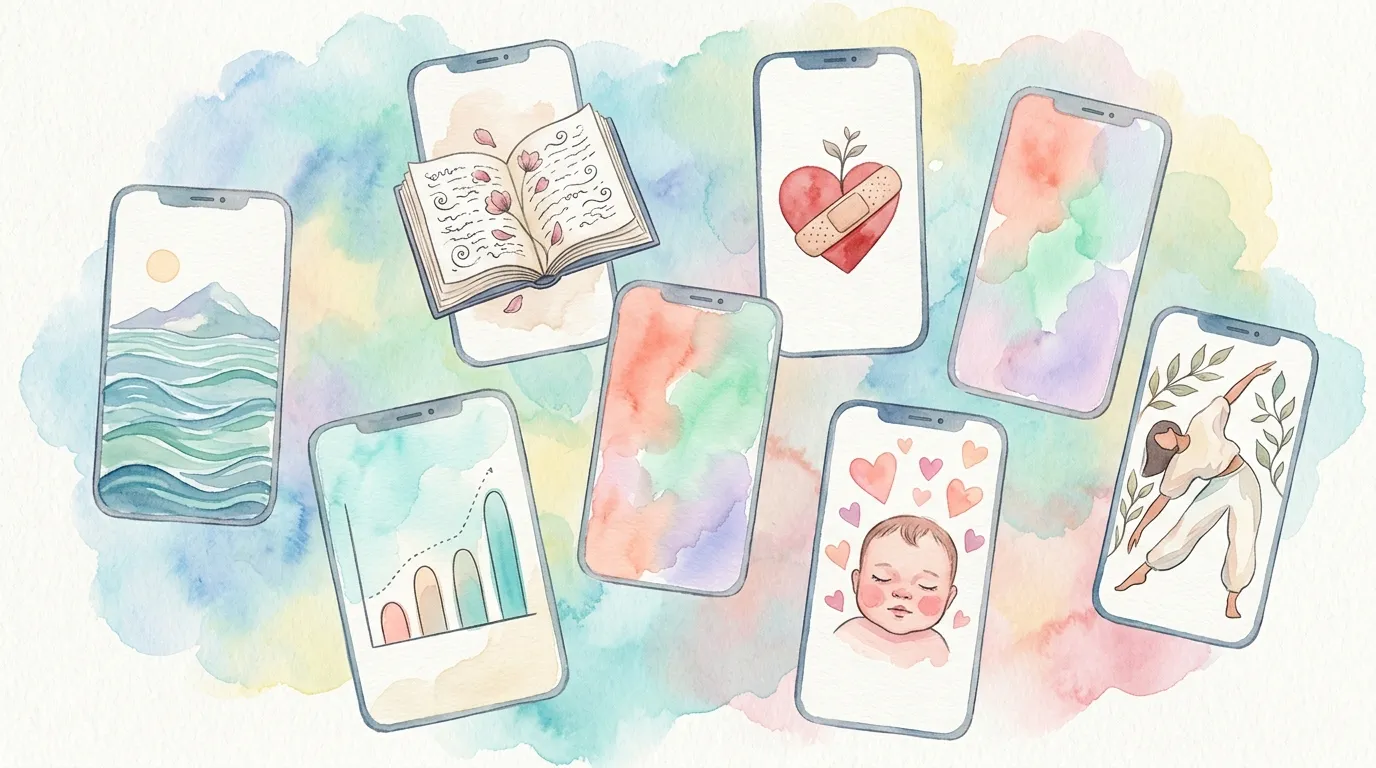
The app store is flooded with self-care apps. Most of them track things without actually helping. Here's what works, by category:
Meditation & Mindfulness
Meditation apps work — but only if you use them consistently. The biggest barrier isn't the app quality; it's building the habit. The apps that work best are the ones that lower the barrier to entry: short sessions (3-5 minutes), guided options, and streak tracking.
Read: Best Meditation Apps 2026
Journaling
Journaling is one of the most evidence-based self-care practices. It reduces anxiety, improves emotional regulation, and strengthens self-awareness. The best journaling apps make it effortless — prompts, templates, and voice input for when you're too tired to type.
Read: Best Journaling Apps 2026
Mental Health
Mental health apps range from CBT-based tools to mood trackers to therapy platforms. The best ones provide specific, actionable techniques rather than vague wellness content.
Read: Best Mental Health Apps 2026
Calming & Stress Relief
Calming apps address the nervous system directly — through sound, breathing exercises, or nurturing interactions. The most effective ones don't just play sounds; they actively shift your neurochemistry.
Read: Calming Apps: 6 That Actually Soothe Your Nervous System
Self-Care Trackers
Gamified self-care apps (like Finch) use virtual pets to motivate daily wellness habits. You take care of yourself by taking care of a digital companion. It's effective because it leverages the nurturing instinct to support your own wellbeing.
Read: Self-Care App Tier List + Self-Care Apps: 7 That Actually Work
Digital Wellbeing: Your Phone Is the Problem and the Solution
The #1 enemy of women's self-care in 2026 is the device you're reading this on.
Phone Addiction
8,100 people search "phone addiction" every month. Another 6,600 search "social media addiction." The average person touches their phone 2,617 times per day. Women spend 4.8 hours per day on mobile — more than any other demographic.
The cycle: You pick up your phone to "check something" → 45 minutes disappear → you feel worse → you pick up your phone again to feel better → repeat.
Read: Phone Addiction: How to Break Free
Doomscrolling
33,100 people search "doomscrolling" every month. It's the compulsive consumption of negative content that makes you feel worse but you can't stop. The neurological mechanism is identical to gambling addiction — variable reward (sometimes the next post is important, usually it's not) keeps you scrolling.
The nurturing replacement: Replace doomscrolling with 5 minutes of AIdorable. The nurturing loop (care → oxytocin → warmth → satisfaction) directly counteracts the doom loop (threat → cortisol → scroll → anxiety). You can't be in both states simultaneously.
Read: Doomscrolling: Why You Can't Stop + Doomscrolling vs Nurturing
Social Media Detox
You don't need to quit social media. You need to change your relationship with it. The 7-day reset: turn off all notifications, delete the 3 apps you scroll most, and replace screen time with specific activities (AIdorable, reading, walking).
Read: Social Media Detox: The 7-Day Reset
Digital Wellbeing Guide
Digital wellbeing isn't about using technology less — it's about using it intentionally. The phone that feeds your anxiety is the same phone that can provide nurturing, connection, and calm. The device isn't the problem. How you use it is.
Read: Digital Wellbeing in 2026
Routines That Actually Change Your Day
Morning Ritual
A consistent morning routine is the single highest-impact self-care practice. Not because mornings are magical, but because the morning sets the neurochemical tone for the entire day. Starting with cortisol (checking phone, rushing) vs. starting with oxytocin (nurturing, connecting) determines how you handle everything that comes after.
The 7-step morning: Wake at same time → water → 5 minutes AIdorable → movement → real breakfast → intention setting → begin. Read the full guide →
Bedtime Routine
The 2 hours before bed determine your sleep quality, which determines everything else. The wind-down: screens off 1 hour before bed → warm shower → 5 minutes AIdorable (nurturing instead of scrolling) → reading → sleep.
Read: Calming Bedtime Routine
Introvert Self-Care
Introverts don't need less self-care — they need different self-care. The 12 practices that actually recharge introverts: solitude (not loneliness), low-stimulation environments, one-on-one connection, and creative expression.
Read: Introvert Self Care: 12 Ways to Recharge
Stress Management: The Complete Toolkit
Stress management isn't one technique — it's a toolkit you draw from based on the type and intensity of stress you're experiencing.
The 10 Techniques That Actually Work
Ranked by evidence and accessibility:
- Deep breathing — 4-7-8 technique activates the vagus nerve, shifting your nervous system to parasympathetic within 60 seconds
- Nurturing — 5 minutes of caring for something (AIdorable) reduces cortisol by 23% through oxytocin release
- Physical movement — even 10 minutes of walking reduces cortisol and increases endorphins
- Progressive muscle relaxation — systematically tensing and releasing muscle groups
- Cognitive reframing — changing the story you tell yourself about the stressor
- Social connection — talking to someone, even briefly, activates co-regulation
- Cold water exposure — splashing cold water on your face triggers the mammalian dive reflex, instantly calming
- Creative expression — writing, drawing, making something channels stress energy
- Nature exposure — even 5 minutes outdoors reduces cortisol measurably
- Laughter — genuine laughter releases endorphins and relaxes muscle tension
Read: Stress Management Techniques: 10 That Work
The 7 techniques:** Box breathing (4 counts in, 4 hold, 4 out, 4 hold), cold water on wrists, 5-4-3-2-1 grounding (5 things you see, 4 you hear, 3 you touch, 2 you smell, 1 you taste), shoulder drop (consciously release tension), physiological sigh (double inhale through nose, long exhale through mouth), self-hug (cross arms and squeeze), and nurturing touch (hold something warm and soft).
Each of these works through a different neurological mechanism. Box breathing regulates CO2 levels. Cold water triggers the dive reflex. Grounding engages sensory processing. The shoulder drop interrupts muscle tension patterns. The physiological sigh activates the vagus nerve most efficiently of any breathing technique discovered.
When to use which: Heart racing → cold water or physiological sigh. Mind racing → 5-4-3-2-1 grounding. Full body tension → shoulder drop + box breathing. Emotional overwhelm → nurturing touch or AIdorable.
Read: How to Calm Down
Women-Specific Self-Care Challenges
Mental Load
The invisible cognitive labor of managing a household, relationships, and family schedules. It's not the physical tasks — it's the mental space they occupy. The constant awareness of what needs to be done, who needs what, and what might go wrong.
Mental load causes a specific type of exhaustion that sleep doesn't fix. Because the load is cognitive, not physical. Your brain is running background processes constantly, consuming executive function resources that should be available for your own needs.
Read: Mental Load Women Carry
Mom Guilt
The persistent feeling that you're failing as a mother — no matter how much you do. Mom guilt isn't proportional to actual parenting quality. The most attentive mothers often feel the most guilt because they have the highest standards for themselves.
Read: Mom Guilt Is Real
Quiet Life
Not everyone wants to hustle. Some women want peace. A quiet life isn't a failed ambitious life — it's a different kind of success. The quiet life movement is about choosing simplicity, depth, and presence over noise, breadth, and productivity.
Read: Quiet Life: Finding Peace
Touch Starvation
The physical need for touch that isn't being met. Touch starvation activates the same neural pathways as social rejection — your brain interprets lack of physical contact as a form of social exclusion. The solution isn't always more people; it's more safe, warm, physical comfort.
Read: Touch Starvation
Self-Care When You're Depressed
When you're depressed, standard self-care advice feels impossible. "Take a bath!" "Go for a walk!" "Call a friend!" You can't do any of those things. That's what depression IS — the inability to do things that would help.
Depressed self-care is minimalist. It's the smallest possible action that moves you 1% in the right direction:
- Can't shower? Wash your face.
- Can't cook? Eat a banana.
- Can't exercise? Stretch for 30 seconds.
- Can't socialize? Open AIdorable for 2 minutes.
- Can't meditate? Take three deep breaths.
- Can't get out of bed? Roll onto your other side.
- Can't read? Look out the window for 10 seconds.
The 1% matters. It's not about feeling better — it's about proving to your brain that action is still possible. Each tiny action rebuilds the neural pathway between "I want to do something" and "I did it." The pathway atrophies during depression. It rebuilds through use.
Why AIdorable works for depression: Nurturing doesn't require motivation. You don't need to "feel like" caring for your baby — you just tap the button. The neurochemical reward (oxytocin, dopamine) comes AFTER the action, not before. This is the opposite of most activities, where you need motivation to start. Nurturing is motivationally cheap and neurochemically expensive — exactly what depression needs.
If depression persists for more than two weeks and includes loss of interest, sleep disruption, or feelings of worthlessness, please consult a mental health professional. You can also call or text 988 (Suicide & Crisis Lifeline).
Read: Self-Care When Depressed: The Minimalist Guide
Self-Care Ideas That Actually Work
Forget the aesthetic. Here are self-care ideas ranked by actual effectiveness:
Highest impact (daily):
- 5 minutes of nurturing (AIdorable)
- 10 minutes of movement
- 7+ hours of sleep
- One genuine conversation
High impact (weekly):
- Journaling session
- Nature exposure (30+ minutes)
- Social connection with someone who sees you
- Creative expression
Medium impact (as needed):
- Meditation
- Digital detox
- New experience
- Learning something
Low impact (enjoyable but overrated):
- Bath bombs
- Face masks
- Retail therapy
- Wine
Read: Self-Care Ideas That Actually Work
The Nurturing Practice: Self-Care Through Caring
Here's the self-care insight that most guides miss: sometimes the most effective self-care is caring for something else.
Not as a distraction. Not as avoidance. But because the act of nurturing activates neurobiological systems that directly counteract stress, loneliness, and emotional depletion. The caregiving system and the stress response system are inversely related — when one is active, the other is suppressed. By activating caregiving, you're literally deactivating stress.
This is why many women report that the most relaxing part of their day isn't meditation, exercise, or screen-free time — it's the 5 minutes they spend caring for their baby on AIdorable. The nurturing practice is self-care that doesn't feel like self-care. It doesn't require willpower, motivation, or discipline. It just requires showing up.
When you care for your baby on AIdorable:
- Oxytocin rises — you feel warm and connected
- Cortisol drops — your nervous system calms
- Dopamine activates — you feel satisfaction from visible growth
- Serotonin stabilizes — the daily routine provides predictability
- The nurturing void fills — your caregiving circuits finally have a target
- Anxiety reduces — the bonding response counteracts the threat response
- Sleep improves — lower cortisol at bedtime means better sleep quality
Five minutes. Every day. That's the prescription. Not because it's the only self-care you need, but because it addresses the specific void — the nurturing void — that underlies so many of the self-care struggles women face. It's the foundation that makes everything else easier.
Read: Self-Soothing Techniques That Work
What to Read Next
Self-care apps:
- Self-Care Apps: 7 That Work
- Self-Care App Tier List
- Best Meditation Apps
- Best Journaling Apps
- Best Mental Health Apps
- Calming Apps
Digital wellbeing:
Routines:
Stress management:
Women-specific:
Self-care ideas:
Games for self-care:
AI companions:
- Best AI Companion Apps
- AI Emotional Support for Women
- Best Companion Apps
- Imaginary Friends for Adults
Emotional wellness:
Nurturing:
Self-care isn't selfish. It's maintenance. You can't pour from an empty cup, and most women are running on fumes while pretending they're fine.
Stop pretending. Start with 5 minutes. Open AIdorable. Care for your baby. Let the nurturing fill the void that's been draining you.
Not because you deserve it (though you do). Because you need it. And needing things is not a weakness — it's what being human means.
Start your self-care practice today at AIdorable.
