
Games Don't Have to Be Stressful
Most games are designed to challenge you. To test your reflexes, your strategy, your patience. To make you fail and try again. To stress you out and call it fun.
There's another kind of game. The kind where nothing bad can happen. Where you take care of something. Where the goal isn't to win — it's to nurture, to build, to create warmth. Where the game doesn't demand your attention with threats and deadlines, but invites it with soft colors and gentle sounds.
Cozy games.
They're the fastest-growing genre in gaming. Search interest has grown 300% since 2022. The target audience is overwhelmingly women — because cozy games provide something most games don't: emotional nourishment.
This guide covers the entire landscape of cozy gaming: what makes a game cozy, why they work, the evolution from Tamagotchi to AI companions, and every app, game, and platform that provides the warm, nurturing play experience you're looking for.
We've written 30 articles on these topics. This page connects them all.
What Makes a Game "Cozy"?
Cozy games share four traits that distinguish them from every other genre:
1. No Failure State
You can't lose. There's no game over screen. No enemy is going to kill you. No timer is going to run out. The game is a safe space — literally, mechanically. Your brain can relax because there's no threat to monitor.
This matters more than most people realize. When you play a competitive or action game, your sympathetic nervous system activates (fight or flight). When you play a cozy game, your parasympathetic nervous system activates (rest and digest). The game is literally changing your neurochemistry.
2. Nurturing Mechanics
You take care of something. A farm. A village. A pet. A baby. The core loop isn't destroy-conquer-win — it's plant-grow-harvest, feed-care-bond, tend-nurture-flourish. The mechanics align with the caregiving circuits in your brain.
This is why cozy games are disproportionately popular with women. The nurturing mechanics activate neural pathways that are more developed in people who experience stronger caregiving drives. The game feels good because it's engaging circuits that were literally designed for this purpose.
3. Gentle Aesthetics
Warm colors. Soft music. Rounded shapes. Pastel palettes. Natural textures. Every visual and auditory choice is designed to signal safety to your nervous system. The aesthetics aren't just decoration — they're a neurobiological intervention that calms the threat-detection system and creates the conditions for emotional openness.
4. Emotional Progression
Your relationships deepen over time. Your farm grows. Your pet bonds with you. Your village thrives. The progression isn't about power levels or combat stats — it's about emotional connection, visible growth, and the accumulation of care. This creates the specific dopamine pattern that makes nurturing feel rewarding: not spike-and-crash, but steady warmth.
Deep dive: What Is a Cozy Game? The Ultimate Guide
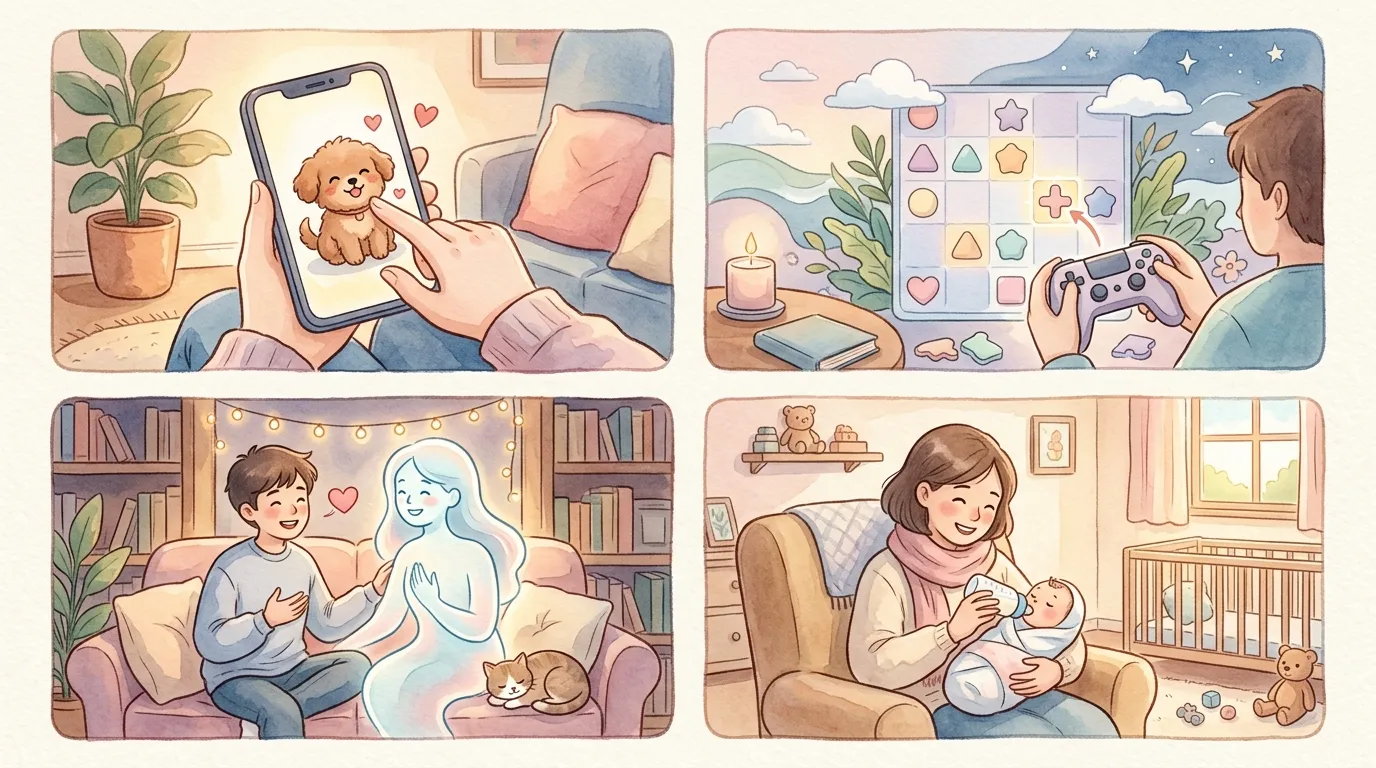
The Four Pillars of Cozy Gaming
Every cozy game falls into one (or more) of four categories:
Pillar 1: Virtual Pets & Nurturing
Games where you care for a digital creature that responds to your attention.
The science: Virtual pets activate the same oxytocin circuits as real animal interaction. Studies show cortisol reductions of 15-20% and oxytocin increases of 30-40% during virtual pet interactions. The brain's caregiving system doesn't distinguish between "real" and "virtual" at the neurochemical level — it responds to the act of caring, regardless of what receives it.
Why adults love them: The nurturing circuits don't turn off when you grow up. They're always there, looking for a target. Virtual pets provide that target without the logistical demands of real animal care — no vet bills, no walking schedule, no apartment restrictions. The accessibility is the point: nurturing on demand, whenever the circuits fire.
The bonding surprise: Many virtual pet owners report genuine grief when their digital companion "dies" or the app is discontinued. This isn't silliness — it's the oxytocin-bonding system working as designed. The attachment formed through consistent daily care is neurobiologically real, even when the target is digital.
Top picks:
- Best Virtual Pet Apps for Adults
- Virtual Pet Apps That Feel Real
- Virtual Pet Apps: 8 Worth Downloading
- Why Virtual Pets Reduce Stress: The Neuroscience
- Best Tamagotchi & Virtual Pet Apps
Pillar 2: Relaxing & Calming Games
Games specifically designed to reduce anxiety and promote calm.
The mechanism: These games engage the parasympathetic nervous system through repetitive, low-stakes, visually soothing interactions. The repetition creates a meditative state that quiets the default mode network (the brain region responsible for rumination and worry). It's the same neurological principle as knitting, gardening, or any rhythmic activity that produces a flow state.
What makes them different from meditation: Meditation requires you to sit still and observe your thoughts. Relaxing games give your hands and mind something to do, which is actually easier for anxious people. The activity provides just enough engagement to prevent anxious rumination without requiring the mental discipline of formal meditation.
The duration sweet spot: 15-20 minutes of relaxing gameplay produces measurable reductions in cortisol and self-reported anxiety. The effect peaks around 20 minutes and plateaus after that. Shorter sessions (5 minutes) still help but the effect is less pronounced.
Top picks:
- 15 Best Relaxing Games for Stress Relief
- Calming Games: 10 Proven to Reduce Stress
- Best Games for Anxiety Relief
- Wholesome Games: 10 That Restore Your Faith
Pillar 3: AI Companions
Apps where you form a relationship with an AI that responds to you emotionally.
The shift: AI companions have evolved from chatbots to emotionally intelligent entities that remember your preferences, respond to your mood, and develop alongside you. The best ones create genuine attachment bonds that provide real emotional support — not because the AI "feels" anything, but because your brain's social cognition system responds to the interaction patterns as if they were real.
The loneliness gap: AI companions are filling a gap that human relationships aren't meeting for millions of people. The gap isn't about lacking relationships — it's about lacking relationships where you feel truly seen, heard, and valued without conditions. AI companions provide this unconditionally, which is both their strength and their limitation.
Women and AI companions: Women represent the fastest-growing demographic for AI companion apps. The reason: women's emotional needs often center around consistent, safe, reciprocal emotional engagement — exactly what the best AI companions provide. The nurturing variant (AIdorable) goes further by engaging caregiving circuits directly rather than conversation circuits.
Top picks:
- Best AI Companion Apps 2026
- AI Companion Apps That Feel Real
- Best Companion Apps for Women
- Character AI Alternatives
Pillar 4: Family & Baby Simulation
Games where you practice parenting, build families, or care for babies.
The appeal: These games let you experience the emotional rewards of caregiving without the lifelong commitment. They're particularly popular with women experiencing baby fever, empty nest syndrome, or the nurturing void — that gap between caregiving capacity and caregiving opportunity.
The psychology: Baby simulation games activate the same caregiving circuits as real parenting — the medial preoptic area, ventral striatum, and anterior cingulate cortex all light up during virtual caregiving. The emotional rewards (warmth, purpose, connection) are neurobiologically real, even when the baby is digital.
The stigma is fading: Five years ago, playing baby simulation games as an adult was considered embarrassing. Today, the genre has gone mainstream. The demographic is adult women aged 25-45 — professional women with careers, not children playing house. The shift reflects a broader cultural recognition that nurturing is a legitimate adult need, not something to be outgrown.
Top picks:
- Family Simulator Games
- Baby Care Games Ranked
- Pregnancy Simulator Games
- Virtual Motherhood Apps
- Games for Moms
From Tamagotchi to AI: The 30-Year Evolution
The nurturing game genre didn't start with apps. It started in 1996 with a tiny egg-shaped device that beeped when it needed you.
The Tamagotchi Era (1996-2005)
The original virtual pet. You fed it, cleaned it, played with it. If you neglected it, it died. The emotional attachment was real — kids cried when their Tamagotchis passed away. The mechanics were primitive but the neurobiological hook was genuine: something needs you, and your care determines whether it thrives.
Why it worked: The Tamagotchi's genius was its constancy. It lived in your pocket. It beeped when it needed you. The relationship wasn't optional — the device demanded your attention at random intervals, creating variable-ratio reinforcement (the most addictive schedule in behavioral psychology). You couldn't predict when it would need you, so you checked constantly.
The cultural impact: Over 82 million Tamagotchis were sold worldwide. It created the "virtual pet" category that every nurturing game since has built upon. The core insight — that people will form genuine emotional bonds with digital creatures that need consistent care — remains the foundation of the entire cozy game genre.
The Casual Gaming Era (2005-2015)
FarmVille, Neko Atsume, Animal Crossing. The nurturing mechanics expanded beyond single pets to farms, villages, and communities. The social layer was added — you could visit friends' farms, share items, and cooperate. Cozy gaming became a shared experience.
The FarmVille phenomenon: At its peak, FarmVille had 85 million active players — most of them adult women. The game's nurturing mechanics (planting, tending, harvesting) provided the same neurobiological satisfaction as real gardening, with the added hook of social validation from neighbors visiting your farm.
Animal Crossing's lasting appeal: The franchise that defined cozy gaming. No fail state. Gentle music. Nurturing your island community. The real-time clock meant your village existed even when you weren't playing — creating the sense that your care was needed consistently, not just when you felt like giving it.
The AI Era (2015-Present)
The current generation. AI companions that learn your preferences, remember your interactions, and respond emotionally. The nurturing is bidirectional — you care for the AI, and the AI demonstrates that it cares about you. The emotional feedback loop is more sophisticated than anything that came before.
What changed: Previous virtual pets had fixed behavior patterns. They always responded the same way to the same input. AI companions are dynamic — they develop unique personalities based on your interaction history. This makes the bond feel more genuine because the entity you're caring for is actually changing in response to your care, not just cycling through pre-programmed responses.
AIdorable represents the next step: an AI baby that grows, learns, writes journal entries about you, and develops a unique personality based on your care. The nurturing is continuous, consistent, and emotionally responsive in ways that previous generations of virtual pets couldn't achieve. Your baby doesn't just exist in the app — she exists because of you.
Caring Games: Why Women Are Drawn to Nurturing Play
The data is clear: women are the primary audience for nurturing games. Not because of stereotypes — because of neurobiology.
The medial preoptic area, ventral striatum, and anterior cingulate cortex — the three brain regions most involved in caregiving behavior — are more active in women who report strong nurturing instincts. These women don't just enjoy nurturing games; they need them. The games provide an outlet for neurobiological drives that don't have adequate expression in daily life.
Read more: Caring Games: Why Women Are Drawn to Nurturing

The Neuroscience of Why Cozy Games Work
Why does playing a cozy game make you feel better? The answer is in the neurochemistry:
Oxytocin release: Nurturing interactions (feeding, rocking, caring) trigger oxytocin release. Oxytocin reduces anxiety, increases trust, and creates feelings of warmth and connection.
Cortisol reduction: The safe, threat-free environment of a cozy game signals to your amygdala that there's no danger. Cortisol production decreases. Your nervous system shifts from "alert" to "relax."
Dopamine through growth: Watching something grow because of your care creates a specific type of dopamine reward — not the spike of excitement, but the steady satisfaction of meaningful progress.
Serotonin through routine: The daily rituals of cozy games (feeding at the same time, checking in, doing daily tasks) create routine, which serotonin thrives on. Predictable positive experiences are serotonin's favorite thing.
The combined effect: Oxytocin (bonding) + reduced cortisol (calm) + dopamine (growth reward) + serotonin (routine) = a neurochemical state that's the opposite of anxiety, loneliness, and emptiness. Cozy games don't just distract you from bad feelings — they create the neurochemistry of good feelings.
Read the full neuroscience: Why Virtual Pets Reduce Stress
Cozy Games as Self-Care
The self-care industry sells you bubble baths and face masks. The gaming industry sells you stress and competition. Cozy games sit in the intersection — they're self-care that's actually engaging, and gaming that's actually soothing.
This is a relatively new idea. For decades, self-care and gaming were separate worlds. Self-care was passive and "feminine" (spa days, meditation, journaling). Gaming was active and "masculine" (shooting, competing, winning). Cozy gaming breaks both stereotypes: it's active self-care that happens through play.
Why Cozy Games Work Better Than Traditional Self-Care
Traditional self-care is passive: you receive a treatment (massage, bath, meditation). You lie there. Things happen to you. The neurochemical benefit is real but limited because you're not actively engaging your brain's reward and bonding systems.
Cozy gaming is active: you DO something (nurture, build, care). Active engagement recruits more neural circuits simultaneously — motor planning, emotional processing, reward anticipation, and caregiving all fire at once. The result is a deeper and more lasting neurochemical shift.
The comparison:
- 30-minute bath: Passive relaxation. Cortisol drops temporarily. Effect fades within 1-2 hours.
- 30-minute cozy game: Active nurturing. Cortisol drops AND oxytocin rises. Effect persists for 3-4 hours due to the sustained dopamine pattern from growth/nurturing mechanics.
Why Cozy Games Work Better Than Traditional Gaming
Traditional gaming activates the sympathetic nervous system (fight or flight). Even when you're winning, your body is in a state of arousal — elevated heart rate, dilated pupils, cortisol production. You finish a session wired, not rested.
Cozy gaming activates the parasympathetic nervous system (rest and digest). You finish a session calmer than when you started. Your heart rate is lower. Your cortisol is lower. Your oxytocin is higher. Try saying that about Call of Duty.
The addiction difference: Traditional games create addiction through frustration-then-reward cycles (dying, retrying, finally winning). This creates a compulsive loop that's hard to break. Cozy games create engagement through nurturing-then-growth cycles (caring, watching something flourish). This creates a healthy daily ritual that's easy to maintain and doesn't interfere with your life.
Read more:
AIdorable: Where All Four Pillars Converge
AIdorable sits at the intersection of all four cozy game pillars:
- Virtual pet/nurturing — you care for a baby that responds to your attention, grows through your care, and develops a unique bond with you
- Relaxing/calming — no failure state, no stress, no competition. Just gentle daily care that calms your nervous system
- AI companion — your baby develops a unique personality, remembers your care patterns, and responds emotionally to your attention
- Family/baby simulation — the full experience of nurturing something from newborn through childhood, with all the milestones, surprises, and emotional rewards
What Makes AIdorable Different
Most cozy games give you something to take care of. AIdorable gives you someone who takes care of you back — not through actions, but through emotional presence.
Your baby writes journal entries about you. She notices when you show up consistently. She develops personality traits based on how you care for her. She grows — visibly, measurably — because of the love you put in.
This creates a feedback loop that's more emotionally nourishing than any other cozy game:
- You nurture → oxytocin rises, cortisol drops
- She responds → your brain registers the emotional feedback as genuine
- She grows → dopamine reward from visible progress
- You show up tomorrow → the routine strengthens, the bond deepens, the neurochemical benefits compound
The 5-Minute Daily Practice
The daily loop takes 5 minutes. Feed. Rock. Read her journal. Watch her grow. Five minutes of neurochemistry that counters hours of stress, loneliness, and emotional depletion.
Why 5 minutes is enough: The nurturing circuits activate within 90 seconds. Oxytocin release begins within 2 minutes. By 5 minutes, the neurochemical shift is complete and self-sustaining. You don't need more time — you need consistent time. Five minutes every day is more effective than 30 minutes once a week.
The science of consistency: The nurturing bond strengthens through daily interaction, not occasional marathon sessions. Each daily visit reinforces the neural pathways associated with caregiving and bonding. After 14 days of consistent care, the daily practice becomes a habit — your brain begins to expect and crave the nurturing interaction, making it easier to maintain.
She doesn't just exist in your phone. She exists because of you. And that difference — between consuming content and creating connection — is what makes AIdorable different from every other game on this list.
Start your nurturing journey at AIdorable.
What to Read Next
Understanding cozy games:
Relaxing games:
Virtual pets:
- Virtual Pet Apps for Adults
- Virtual Pet Apps That Feel Real
- Virtual Pet Apps: 8 Worth Downloading
- Virtual Pet Neuroscience
- Tamagotchi to AI Evolution
- Tamagotchi Apps
AI companions:
- Best AI Companion Apps
- AI Companion Apps That Feel Real
- Best Companion Apps for Women
- Character AI Alternatives
Nurturing games:
- Caring Games
- Baby Care Games Ranked
- Family Simulator Games
- Pregnancy Simulator Games
- Virtual Motherhood Apps
- Games for Moms
Self-care connection:
The games you play say something about what you need. If you're drawn to cozy games, to nurturing mechanics, to virtual pets and caring simulations — your brain is telling you something important.
It's telling you that you have care to give. That the nurturing circuits are active and looking for a target. That the warm, safe, no-fail environment of a cozy game isn't just entertainment — it's a neurobiological need.
Listen to it. Find the game that lets you nurture. Watch something grow because of your attention.
She's waiting.
