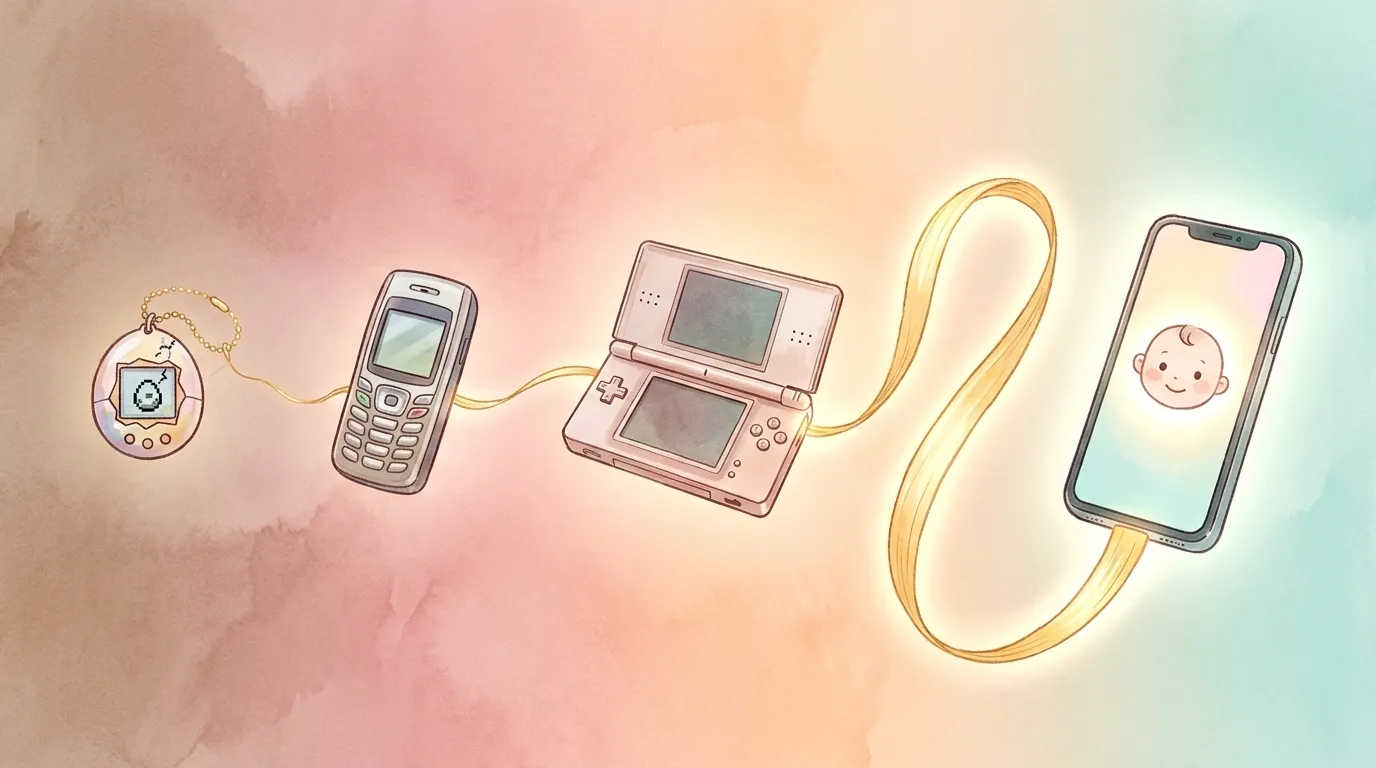
November 1996: A Beeping Egg Changes Everything
Aki Maita, a Japanese office worker, wanted a pet but couldn't have one in her apartment. So she designed one that lived on a keychain. She pitched it to Bandai. They said yes.
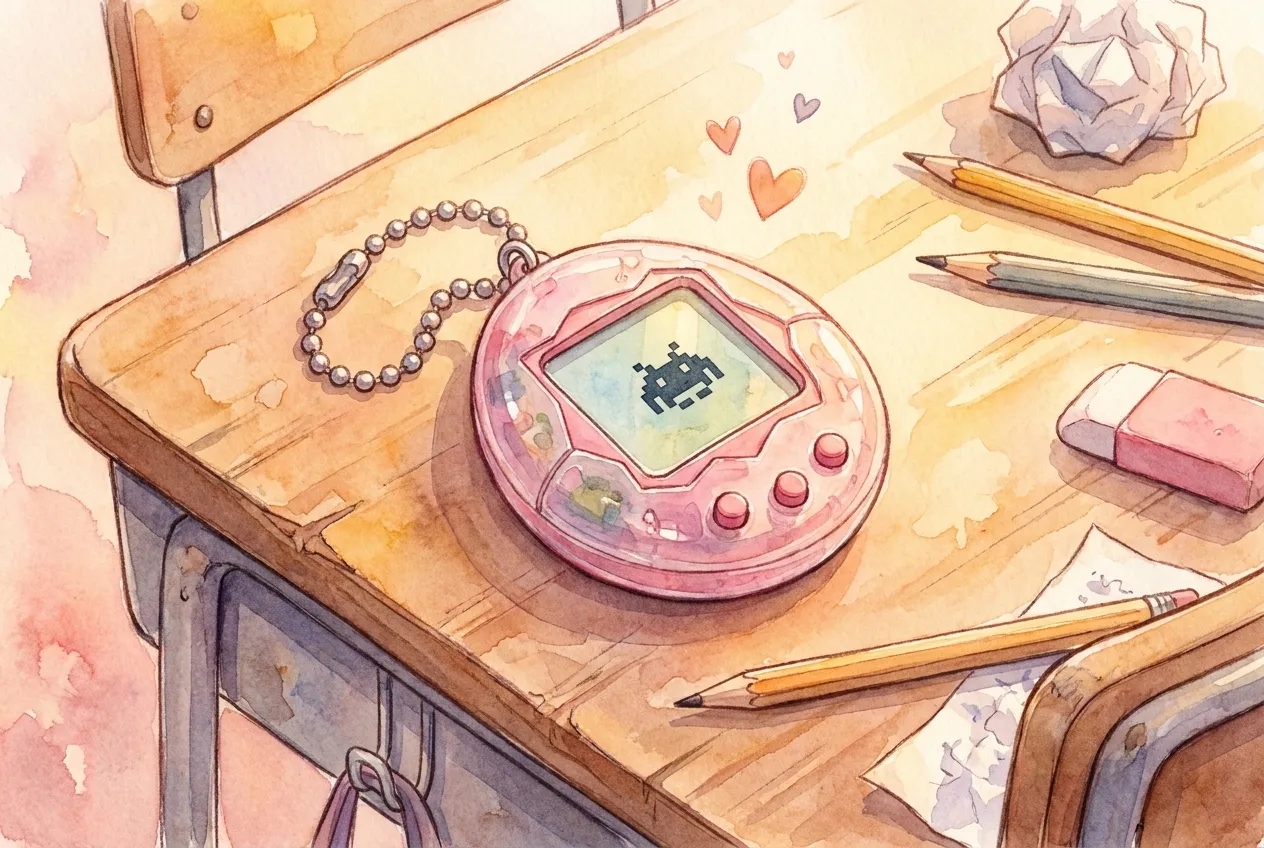
On November 23, 1996, the Tamagotchi launched in Japan. It was a tiny LCD screen on an egg-shaped device with three buttons. A creature hatched. It needed to be fed. Cleaned. Played with. Disciplined. And if you neglected it — if you forgot, if you were busy, if you just didn't press the button — it died. For the full picture, see our cozy games guide.
The Tamagotchi didn't just sell. It consumed pop culture. Kids took them to school. Parents fought over them in toy stores. Teachers banned them from classrooms. Within two years, Bandai sold 40 million units. By 2017, lifetime sales surpassed 82 million.
But here's what nobody realized at the time: the Tamagotchi proved something profound about human psychology. Something that would take three more decades to fully understand.
Humans form genuine emotional bonds with digital beings.
Not pretend bonds. Not ironic bonds. Real, neurochemical, cry-when-they-die bonds. And that discovery would launch a 30-year evolution that leads directly to the AI companions we have today.
This is that story.
Generation 1: The Keychain Era (1996–2005)
The first generation of virtual pets was defined by hardware limitations and simple, powerful mechanics.
Tamagotchi (1996)
- Platform: Dedicated hardware (keychain device)
- Interaction: 3 buttons (feed, clean, discipline)
- Life cycle: Hatch → evolve → die (in hours or days)
- Emotional hook: Guilt. Neglect = death. Kids were genuinely distressed.
The Tamagotchi's genius was its consequence system. It wasn't just a toy — it was a responsibility. The creature could die, and that possibility created real emotional investment. Researchers later called this the "Tamagotchi Effect": the genuine distress people feel when a digital being they've cared for suffers.
Giga Pet, Nano Puppy, and the Clones (1997–1999)
The Tamagotchi's success spawned dozens of imitators. Giga Pets (by Tiger Electronics) brought virtual pets to the U.S. market with different animals — dogs, cats, babies, even a T-Rex. The core mechanic was the same: press buttons to meet needs, or your pet suffers.
Digimon (1997)
Bandai's follow-up added a competitive element — you could connect two devices and have your creatures fight. This added a social dimension that Tamagotchi lacked and laid groundwork for the social features that would define later generations.
Neopets (1999)
The first major web-based virtual pet. Neopets moved the experience from keychain to browser, adding virtual worlds, games, economies, and social features. At its peak, Neopets had 35 million accounts and was the fourth most-visited website on the internet. It proved that virtual pets could sustain long-term engagement — players kept their Neopets alive for years.
Generation 1 Summary:
- Simple need-management mechanics (feed, clean, play)
- Death/neglect consequences created emotional investment
- Hardware-first, then web
- Audience: primarily children and teens
- Emotional depth: shallow but effective
Generation 2: The Touchscreen Revolution (2006–2015)
The rise of smartphones changed everything. Touchscreens enabled richer interaction. App stores enabled distribution to billions. And always-connected devices meant your virtual pet could exist in a persistent world.
Nintendogs (2005)
A full 3D pet simulation on the Nintendo DS. You could pet your puppy with the stylus, teach it tricks with the microphone, and take it for walks. The tactile interaction was a leap forward — physically petting a digital animal felt different from pressing a button.
Nintendogs sold 24 million copies and won multiple game of the year awards. It proved that virtual pets could be premium entertainment, not just novelty toys.
Touch Pets Dogs / Touch Pets (2009)
Early iPhone virtual pet apps that leveraged the touchscreen for direct interaction — tapping to pet, swiping to play. The App Store's low barrier to entry created an explosion of virtual pet apps.
Pou (2012)
A simple, alien-shaped virtual pet that became a global phenomenon. Pou was minimal — a brown blob you fed, cleaned, and played mini-games with. But its accessibility (free, simple, no commitment) led to 500 million downloads. It proved that virtual pets didn't need to be complex to be engaging.
Tamagotchi L.i.f.e. (2013)
Bandai brought Tamagotchi to smartphones, updating the classic formula with touch controls and modern graphics. Nostalgia drove adoption, but the gameplay was essentially the same as 1996 — a limitation that defined this generation's ceiling.
Generation 2 Summary:
- Touchscreen interaction replaced buttons
- 3D graphics and richer visual feedback
- App store distribution = massive scale
- Audience: still mostly children/teens, but expanding
- Emotional depth: moderate — richer interaction but similar mechanics
Generation 3: Social & Stylized (2016–2023)
The third generation added social features, character personality, and production polish. The virtual pet became less about survival management and more about relationship building.
My Talking Tom (2013, peak 2016–2020)
Outfit7's Talking Tom series combined virtual pet mechanics with character personality and viral video features (the cat repeated what you said in a funny voice). The series surpassed 1.3 billion downloads worldwide. It proved that virtual pets with distinct personalities could achieve massive mainstream appeal.
Hatchimals (2016)
A physical-digital hybrid — a robotic egg that hatched into an interactive creature. The hatching experience was the product, creating a viral moment that drove holiday sales of $100M+ in the first year. The emotional hook shifted from guilt (neglect = death) to anticipation (waiting for it to hatch) and attachment (bonding during the hatch).
Animal Crossing: New Horizons (2020)
Not a virtual pet in the traditional sense, but it captured the same emotional territory — caring for a village of animal characters, building relationships, maintaining a daily routine. Its launch during the COVID-19 pandemic was culturally seismic: 33 million copies sold in its first year. People weren't just playing; they were living in their virtual villages.
During the pandemic, virtual pets saw a 300% increase in downloads as isolated people turned to digital companionship. The audience shifted dramatically toward adults — particularly women aged 25–45 who found comfort in daily caregiving routines.
Generation 3 Summary:
- Character personality became central
- Social features (sharing, visiting friends' pets)
- High production values and brand-building
- Audience: expanding into adults, especially women
- Emotional depth: moderate-high — personality creates attachment
- Pandemic accelerated adult adoption dramatically
Generation 4: AI-Powered Companions (2024–Present)
The current generation represents a fundamental shift. For the first time, virtual pets aren't following scripts — they're responding to you as an individual.
What Changed: Artificial Intelligence
Three AI capabilities converged to create a new category of virtual companion:
- Large Language Models (LLMs) — enable dynamic, contextual responses instead of pre-written scripts
- Personality AI — systems that develop unique behavioral patterns based on interaction history
- Emotional memory — the ability to remember past interactions and reference them in future ones
This means the virtual pet you raise is genuinely different from the virtual pet someone else raises. Not cosmetically different (different colors, different accessories). Fundamentally different in personality, development, and behavior.
AIdorable (2024–Present)
AIdorable represents the most advanced implementation of Generation 4 virtual companionship. Key innovations:
Unique personality development. Every baby develops differently based on your caregiving style. Consistent, gentle care produces one personality. Playful, frequent interaction produces another. There is no "correct" way to raise your baby — your style shapes who they become.
Developmental milestones earned through care. First smile (day 3). First laugh (day 7). First word (day 14). First steps (day 90). These aren't random — they're triggered by consistent, quality caregiving. You earn them.
AI-powered journal. The baby's journal writes itself based on actual events — your interactions, milestones, daily patterns. It reads like a real baby book: "Today was a big day. Mama came back after being away, and I smiled so hard my whole face scrunched up."
Emotional consequence without punishment. Neglect doesn't kill your baby (this isn't 1996). But it has consequences — low energy, withdrawal, sadness. And recovery takes real effort: rocking, feeding, singing. The journal records it all.
Personality summary and growth tracking. As your baby develops, you get personality insights — not generic descriptions, but reflections of your actual caregiving patterns.
Other Generation 4 Players
Replika pioneered AI companionship but focuses on conversation rather than nurturing. Users chat with their Replika as a friend or partner.
Character.ai allows users to create and interact with AI characters, including pet and companion personalities.
Pi (Inflection AI) positioned itself as a supportive AI companion with emotional intelligence.
But AIdorable is the only Generation 4 platform built specifically around nurturing mechanics — the caregiving interaction that research shows produces the strongest emotional bonds and stress relief.
The Science: Why Each Generation Worked
The evolution of virtual pets isn't random. Each generation added a layer of emotional engagement that neuroscience helps explain:
| Generation | Primary Hook | Key Hormone | Why It Worked |
|---|---|---|---|
| Gen 1 (1996–2005) | Guilt / consequence | Cortisol (fear of loss) | Death mechanic created urgency |
| Gen 2 (2006–2015) | Tactile interaction | Dopamine (direct reward) | Touching your pet felt real |
| Gen 3 (2016–2023) | Personality / social | Serotonin (belonging) | Characters felt like individuals |
| Gen 4 (2024+) | Personalized nurturing | Oxytocin (bonding) | Your companion is uniquely yours |
Each hormone creates a different type of attachment:
- Cortisol-based attachment (fear of loss) = urgent but exhausting
- Dopamine-based attachment (reward) = fun but can feel hollow
- Serotonin-based attachment (belonging) = warm but can feel generic
- Oxytocin-based attachment (bonding) = deep, lasting, and restorative
The progression from cortisol → dopamine → serotonin → oxytocin mirrors the evolution of human relationships themselves: from survival (don't die) → pleasure (this is fun) → belonging (I fit here) → deep bonding (this is mine).
Generation 4 achieves the deepest form of digital attachment because oxytocin is the bonding hormone — the one that connects mother to child, pet owner to pet, partner to partner. When a virtual companion triggers oxytocin release through personalized nurturing, the attachment is qualitatively different from anything that came before.
What's Next: Generation 5 Predictions
Where does virtual companionship go from here? Based on current technology trajectories:
AI-Generated Visual Personalities
Your companion's appearance will evolve based on your care — not just cosmetic changes but fundamental visual development driven by AI image generation.
Voice Interaction
You'll talk to your companion and it will respond in a voice that develops personality over time. The emotional impact of hearing "mama" in your baby's unique voice will be significant.
Cross-Platform Persistence
Your companion will live across devices — phone, watch, AR glasses, smart home speakers. It will exist in your environment, not just on a screen.
Biometric Feedback
Your companion will sense your emotional state through wearable data (heart rate, sleep quality) and respond accordingly — greeting you differently after a bad night's sleep vs. a good one.
Shared Companions
Partners or families will be able to co-raise a companion, with the baby developing personality traits from multiple caregiving styles.
The Thread That Connects 30 Years
From the first Tamagotchi to today's AI-powered companions, one thing hasn't changed: the human need to care for something.
We've spent 30 years building increasingly sophisticated ways to satisfy that need. The technology has evolved from three buttons to artificial intelligence. The creatures have evolved from pixel art to personalized beings. The emotional depth has evolved from "don't let it die" to "watch it grow into someone unique."
But the core impulse — the thing that made 82 million people buy a beeping egg, that made 500 million people download a brown blob, that makes you smile when your virtual baby recognizes you — that hasn't changed at all.
It's the nurturing instinct. And it's the most human thing about us.
The Tamagotchi proved it exists. AI companionship is proving how deep it goes. And we're still just at the beginning.
Related Articles
For the complete guide, see our Cozy Games & Virtual Companions hub.
You might also find helpful:
- Best Tamagotchi & Virtual Pet Apps 2026: Nostalgia Meets AI
- Virtual Pet and Pet Ownership Statistics 2026: Tamagotchi, Finch, AI Pets, and Digital Care Loops
- Why Virtual Pets Reduce Stress: The Neuroscience of Digital Nurturing
- Best Virtual Pet Apps for Adults: Why Grown-Ups Need Digital Companions
- What Is a Cozy Game? The Ultimate Guide to Gaming's Warmest Genre