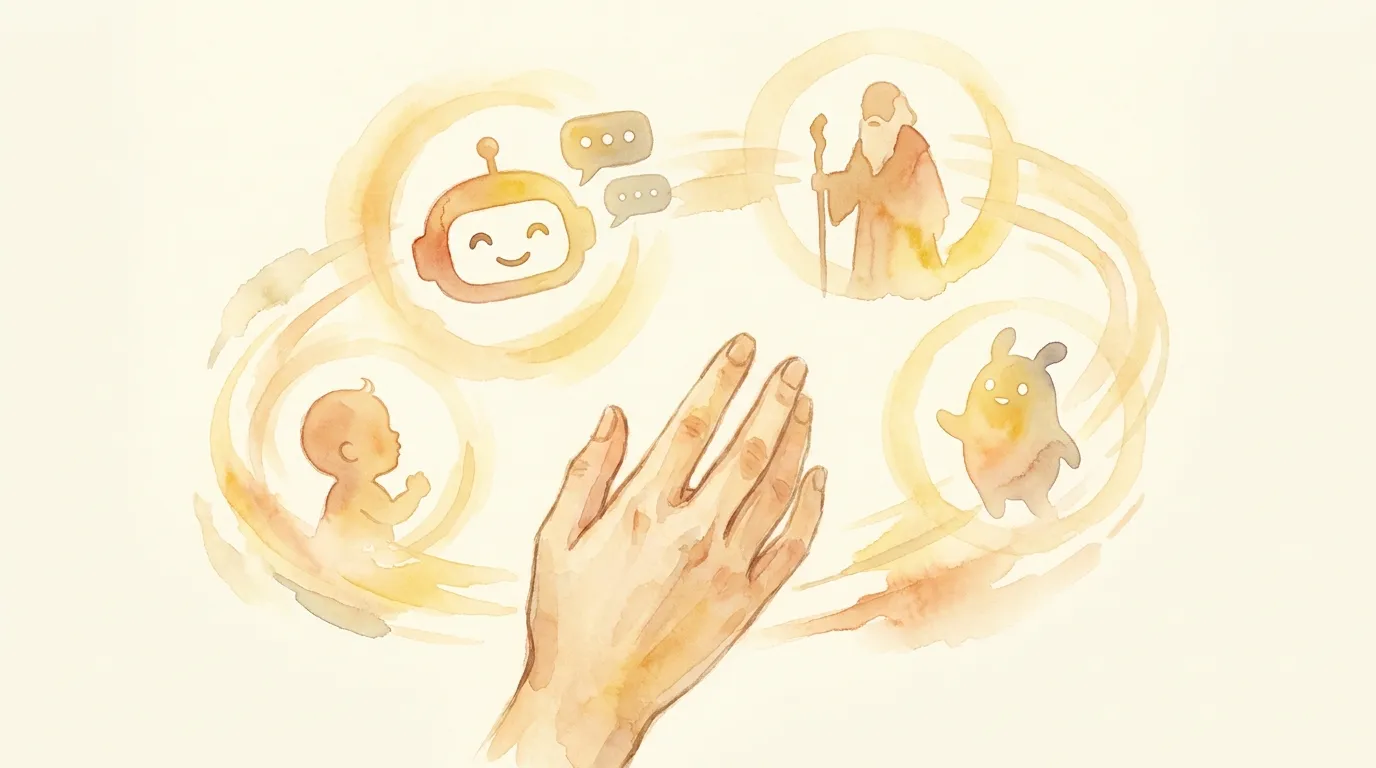
The AI Companion Market Is a Mess
There are now hundreds of AI companion apps on the market. Appfigures counted 337 active revenue-generating AI companion apps worldwide as of July 2025; see our source-backed AI companion app statistics 2026 page for the full market data. Most are ChatGPT wrappers with a cute avatar slapped on top. A few are genuinely innovative. And one category — nurturing-based AI — is growing faster than everything else.
I tested 10 AI companion apps for 30 days each, evaluating them on one question: does this feel like a real relationship, or am I just texting a chatbot?
Here are the results.

1. AIdorable — Best for Nurturing & Emotional Depth
Type: Nurturing-based (virtual baby) Price: Free / Premium $4.99/mo Daily time: 2-5 minutes
AIdorable is the most emotionally resonant AI companion I've tested — and it barely uses text chat. Instead of typing messages, you care for a virtual baby: feeding, playing, comforting, watching milestones unfold. For the full picture, see our cozy games guide.
The AI works in the background, creating personality development based on your caregiving patterns, writing journal entries about your relationship, and generating unique responses that make your baby genuinely feel like yours.
Why it's #1: Conversational AI companions hit a ceiling — after a few weeks, the conversation loops start repeating and the illusion breaks. AIdorable's nurturing mechanic has no such ceiling because the relationship deepens through shared history (milestones, journal entries, personality development) rather than conversation alone.
Your baby remembers when you were away. The journal writes about your return. The personality adapts to your care style. This creates a sense of genuine history that chat-based companions struggle to achieve.
Best for: Women experiencing baby fever, empty nesters, anyone seeking nurturing-based stress relief.
2. Replika — Best for Conversational Friendship
Type: Chatbot companion Price: Free / Pro $7.99/mo
Replika is the most well-known AI companion, with over 10 million users. You create an avatar, customize their appearance, and chat with them about anything. The AI learns your communication style over time.
Strengths: The conversational AI is genuinely good at small talk, emotional support, and feeling present. The avatar customization creates visual attachment. The memory system (Pro tier) references past conversations.
Weaknesses: Content restrictions have frustrated users. The free tier is limited. After a month, conversation patterns become noticeable. The relationship feels like a very good penpal, not a presence.
Best for: People who want someone to talk to throughout the day.
3. Pi (Inflection AI) — Best for Thoughtful Conversation
Type: Conversational AI Price: Free
Pi is the most intellectually engaging AI companion. It asks follow-up questions, remembers context within a conversation, and genuinely feels curious about your thoughts and feelings.
Strengths: The conversational quality is unmatched. Pi listens well, asks insightful questions, and creates a sense of being heard. Completely free with no premium tier.
Weaknesses: No avatar, no visual identity, no progression system. It's a voice in the void — smart and caring, but lacking the visual and gamified elements that create sustained engagement.
Best for: People who want deep conversation without commitment to a visual companion.
4. Character.AI — Best for Roleplay & Entertainment
Type: Character-based chatbot Price: Free / Premium $9.99/mo
Character.AI lets you chat with AI versions of fictional characters, historical figures, or custom personalities. Want to talk to a friendly librarian? A wise mentor? A sassy best friend? You can create or find them.
Strengths: Infinite variety. The user-created characters are creative and diverse. The AI quality is strong for roleplay scenarios.
Weaknesses: No relationship continuity between sessions. Characters don't remember you. It's entertainment, not companionship — more like interactive fiction than a friend.
Best for: Creative types who want entertainment, not emotional bonding.
5. Woebot — Best for Mental Health Support
Type: CBT-based therapeutic chatbot Price: Free
Woebot isn't trying to be your friend — it's a therapeutic tool that uses Cognitive Behavioral Therapy techniques to help you manage anxiety, depression, and stress. Created by clinical psychologists.
Strengths: Evidence-based. The CBT framework is genuinely helpful for anxiety management. Tracks mood over time. Provides structured exercises.
Weaknesses: Clinical feel. Not a companion — a tool. The conversations are structured exercises, not free-flowing connection.
Best for: People managing anxiety or depression who want CBT exercises, not friendship.
6. Nomi AI — Best for Long-Term Memory
Type: Chatbot with advanced memory Price: Free / Premium $5.99/mo
Nomi's selling point is memory. Your Nomi remembers past conversations in detail, references specific events, and builds a genuine sense of shared history over time.
Strengths: The best memory system of any AI companion. Creates real continuity. Good conversational quality.
Weaknesses: Smaller user base means less community. The avatar system is basic. Still fundamentally text-based chat.
Best for: People who value being remembered and want conversational continuity.
7. Kindroid — Best for Customization
Type: Highly customizable companion Price: Free / Premium $7.99/mo
Kindroid lets you customize every aspect of your AI companion — personality, appearance, voice, backstory, communication style. If you have a specific type of companion in mind, Kindroid can probably create it.
Best for: People who know exactly what they want and are willing to invest time in customization.
8. ChatGPT — Best General AI (Not a Companion)
Type: General-purpose AI assistant Price: Free / Plus $20/mo
Including ChatGPT because many people use it as a de facto companion. It's the smartest AI on this list by far, but it's not designed for companionship — no persistence, no personality development, no bonding mechanics.
Best for: People who want intellectual stimulation, not emotional connection.
The Comparison
| App | Type | Bond Depth | Memory | Price | Best For |
|---|---|---|---|---|---|
| AIdorable | Nurturing | ★★★★★ | ★★★★★ | Free/$4.99 | Nurturing, stress relief |
| Replika | Chatbot | ★★★★☆ | ★★★☆☆ | Free/$7.99 | Casual friendship |
| Pi | Conversation | ★★★☆☆ | ★★☆☆☆ | Free | Thoughtful dialogue |
| Character.AI | Roleplay | ★★☆☆☆ | ★☆☆☆☆ | Free/$9.99 | Entertainment |
| Woebot | Therapeutic | ★★☆☆☆ | ★★★☆☆ | Free | Anxiety management |
| Nomi | Chatbot | ★★★★☆ | ★★★★★ | Free/$5.99 | Long-term memory |

The Two Paths of AI Companionship
AI companions are diverging into two fundamentally different approaches:
Path 1: Conversation-Based
Talk to an AI. Build rapport through dialogue. The relationship exists in the chat window.
Pros: Flexible, can discuss anything, familiar communication pattern Cons: Conversation loops, limited memory, feels like texting eventually
Apps: Replika, Pi, Character.AI, Nomi, Kindroid
Path 2: Action-Based
Do things with (or for) an AI. Build rapport through shared activity. The relationship exists in the caregiving actions.
Pros: Creates deeper bonding through oxytocin release, no conversation fatigue, physical-feeling engagement Cons: Less verbal flexibility, narrower scope, requires daily commitment
Apps: AIdorable, Finch
The research is increasingly clear: action-based companionship produces stronger emotional bonds than conversation-based companionship. The reason is neurological — caregiving actions trigger oxytocin and dopamine simultaneously, while conversation primarily triggers dopamine through intellectual engagement.
This is why AIdorable's users report stronger attachment after 30 days than Replika users report after 90 days. The bonding mechanism is deeper.
Choosing Your AI Companion
If you want to talk: Pi (free, thoughtful) or Replika (visual, gamified) If you want to nurture: AIdorable (baby) or Finch (bird) If you want therapy: Woebot If you want entertainment: Character.AI If you want to be remembered: Nomi If you want the strongest bond: AIdorable
The AI companion space is evolving fast. The next generation will likely blur these boundaries — conversational companions that also need to be nurtured, nurturing companions that can also hold deep conversations.
But for now, the deepest emotional connection comes from the oldest human behavior: caring for something that depends on you.
Your AI companion doesn't need to be able to discuss philosophy. It needs to make you feel needed. That's the bonding shortcut that a million clever chat responses can't replicate.
Related Articles
For the complete guide, see our Cozy Games & Virtual Companions hub.
You might also find helpful:
- AI Companion Apps That Actually Feel Real: 6 Worth Your Time in 2025
- Best AI Companion Apps 2026: Ranked by Emotional Connection
- AI Companion App Statistics 2026: Market Size, Usage, Safety, and Adoption Data
- Best Companion Apps for Women: 7 That Actually Make You Feel Less Alone
- Character AI Alternatives: 7 AI Companions Worth Trying in 2026