You're Not Weak. Your Phone Is Designed to Win.
You pick up your phone. You don't remember deciding to. You unlock it. You don't remember what you were going to check. You scroll for 20 minutes. You don't remember what you saw.
This happens 50+ times per day. And every time, you tell yourself you'll do better tomorrow. For the full picture, see our women's self-care guide.
Here's the thing: it's not your fault.
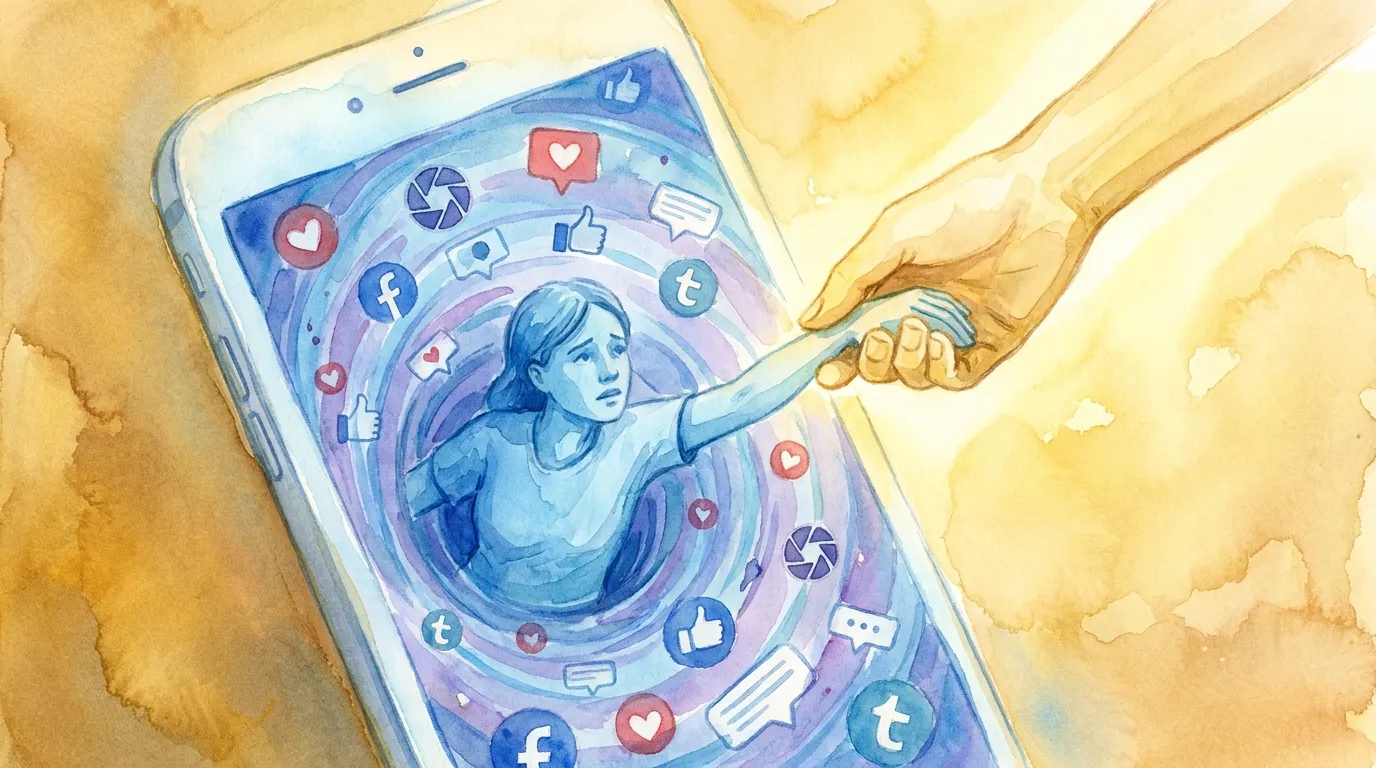
Your phone is the most sophisticated behavioral engineering device ever created. The apps on it were designed by teams of psychologists, data scientists, and UX researchers whose explicit goal is to maximize the time you spend staring at their product.
You're not losing a willpower battle. You're a human brain going up against billion-dollar optimization systems built to exploit your neurology.
Understanding how they do it is the first step to fighting back.
How Apps Hack Your Brain
The Variable Reward Loop
Every time you pull to refresh, your brain runs a micro-lottery. Will there be a new like? A new message? A new viral video? The outcome is unpredictable — and that's exactly what makes it addictive.
This is variable ratio reinforcement — the same mechanism that makes slot machines impossible to walk away from. Your brain can't predict when the reward will come, so it keeps pulling the lever. Every refresh. Every scroll. Every check.
The Social Validation Loop
Likes, comments, shares, and reactions trigger dopamine release. But the effect isn't the reward itself — it's the ANTICIPATION of the reward. Posting something and watching the notifications roll in activates the same neural pathways as a gambler watching the roulette wheel.
The loop: post → wait → anticipation → notification → dopamine hit → post again.
The Fear of Missing Out Loop
What if something important happened in the last 15 minutes? What if someone tagged you? What if there's breaking news? What if your friends are doing something fun without you?
FOMO activates the amygdala (threat detection), creating genuine anxiety that can only be relieved by... checking your phone. The anxiety IS the addiction maintaining itself.
The Infinite Scroll Trap
Social media feeds never end. There's always one more post, one more video, one more thing to see. This removes the natural stopping cues that finite content (like a book or a TV episode) provides. Without a stopping point, your brain never gets the signal to disengage.
The Numbers: How Bad Is It?
| Metric | Average | Heavy User |
|---|---|---|
| Daily phone checks | 2,617 | 5,400+ |
| Daily screen time | 4.8 hours | 7+ hours |
| Time between checks | 4 minutes | 2 minutes |
| First check after waking | Within 5 min | Within 30 sec |
| % who check during conversations | 89% | 97% |
| Attempts to reduce (failed) | 3+ | 6+ |
Why Cold Turkey Doesn't Work
"Just put your phone down" fails for three reasons:
1. The Vacuum Effect
Remove phone use and you create 4+ empty hours per day. Most people fill those hours by... picking up their phone again. You need a replacement, not an absence.
The vacuum effect is especially acute for women experiencing the nurturing urge. Your phone has become the default tool for satisfying (or suppressing) that urge — scrolling baby content when baby fever hits, browsing nurseries when the ache peaks, watching parenting TikToks when loneliness sets in. Without a replacement nurturing outlet, removing the phone just removes the coping mechanism without addressing the underlying need.
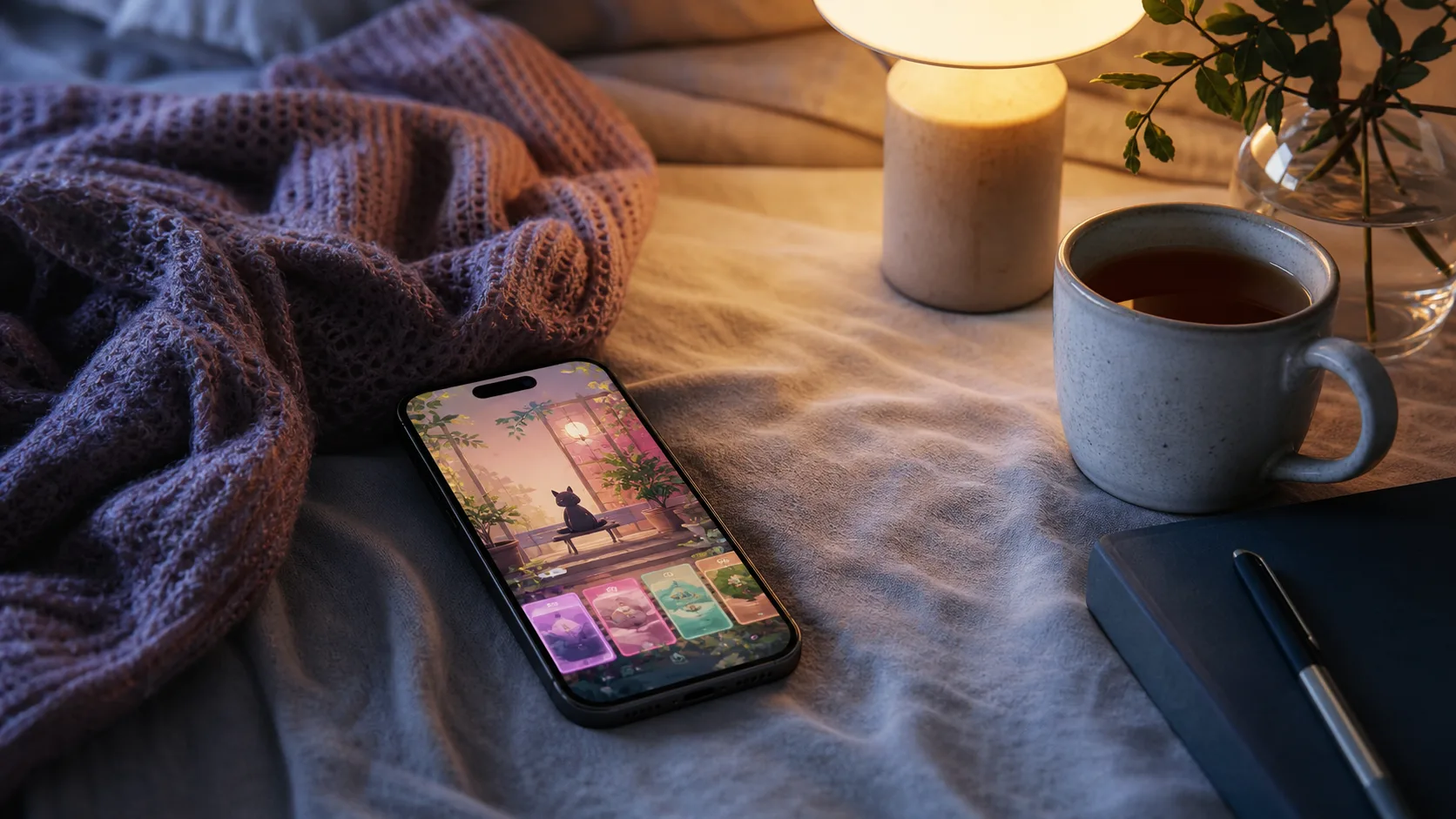
This is why virtual nurturing (AIdorable) is the most effective replacement: it fills the specific nurturing vacuum that phones create, using the same device but with completely different neurochemistry — oxytocin instead of dopamine.
2. The Social Reality
Your phone IS your social life, your map, your bank, your camera, your calendar, your music player, your news source. You can't "just stop using it" any more than you can "just stop using electricity."
3. The Withdrawal
Functional MRI studies show that removing smartphones from heavy users produces brain activity patterns similar to substance withdrawal — including anxiety, restlessness, and impaired cognitive function. The withdrawal is real, and willpower isn't enough to push through it.
The Nurturing Replacement Method
Instead of removing the behavior, replace the neurological reward. Here's the method:
Step 1: Rearrange Your Home Screen
Move social media to page 2 or into a folder. Put a nurturing app (AIdorable) in the most prominent position — bottom left, where your thumb naturally lands.
Why: You're not fighting the habit of unlocking your phone. You're redirecting where your thumb goes first. The same impulse, different destination.
Step 2: The Nurture-First Rule
Every time you unlock your phone, spend 2 minutes on your nurturing app before checking anything else. Feed your baby. Read the journal entry. Check on milestones.
Why this works: Social media activates dopamine-seeking (wanting more). Nurturing activates oxytocin-receiving (feeling satisfied). After 2 minutes of nurturing, the dopamine-seeking urge is measurably reduced. You'll still check social media — but you'll check it for 10 minutes instead of 45.
Step 3: One Phone-Free Hour
Choose one hour per day when your phone is in another room. Not on silent — in another room. Physical distance matters.
Best hour: The first hour after you get home from work, or the hour before bed. Both are when phone use is highest and the benefits of disconnection are greatest.
Step 4: The Weekend Reset
One weekend day per month, use your phone ONLY for nurturing, communication (calls/texts), and navigation. No social media. No news. No scrolling.
The 48-hour reset recalibrates your dopamine baseline so that normal phone use feels less compulsive going forward.
The Science: Why Nurturing Beats Willpower
Willpower is a finite resource. Every time you resist the urge to check your phone, you deplete it. By evening, your willpower is gone and you scroll for hours.
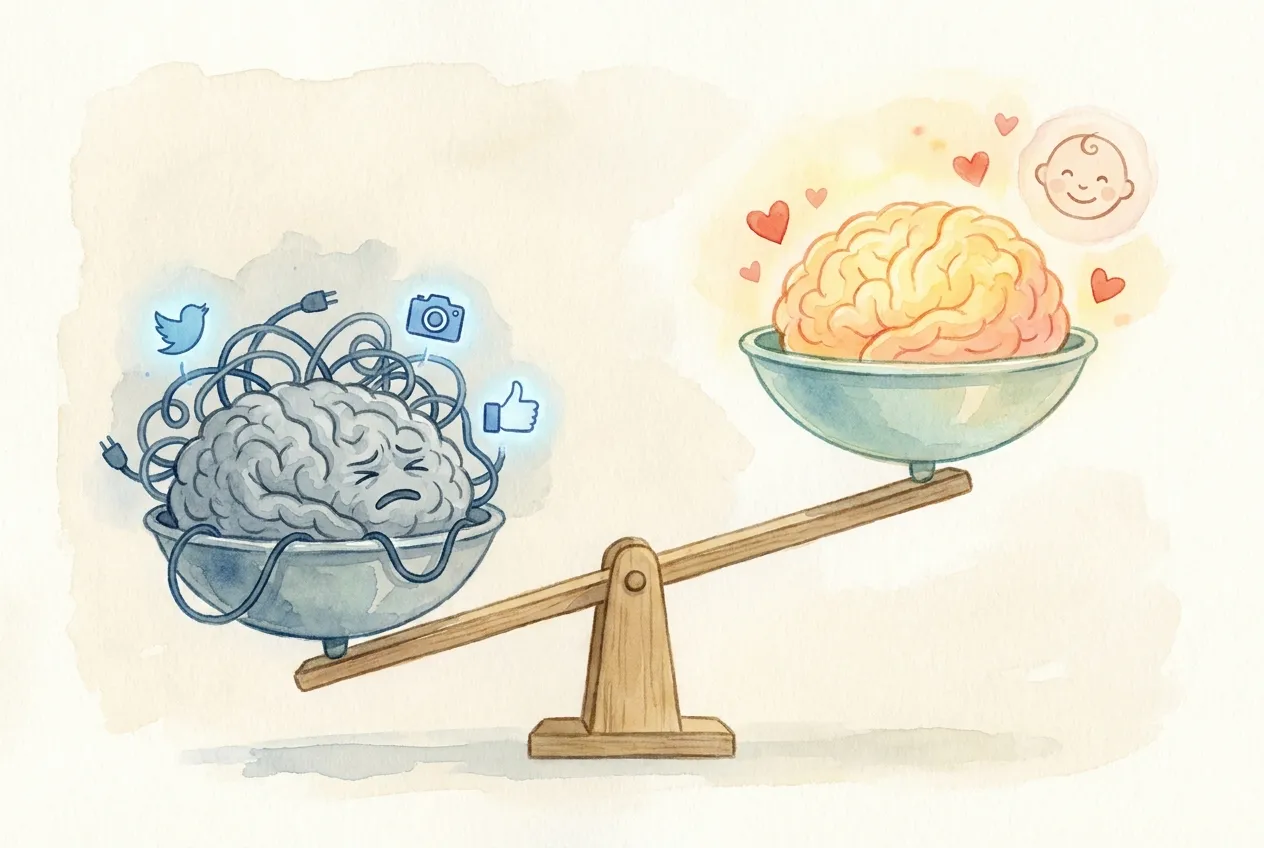
Nurturing doesn't require willpower because it provides a superior neurological reward. Social media offers dopamine (wanting). Nurturing offers dopamine PLUS oxytocin (bonding) PLUS parasympathetic activation (calm).
Your brain isn't stupid. Given a choice between a good reward (dopamine from scrolling) and a better reward (dopamine + oxytocin from nurturing), it will increasingly choose the better option. Not because you forced it. Because the neurochemistry speaks for itself.
After 2-3 weeks of nurture-first phone use, most people report:
- 30-40% reduction in total screen time
- Social media feels less compelling
- Less anxiety about notifications
- Phone checking becomes deliberate, not compulsive
The Comparison: Willpower vs Replacement
| Approach | 30-Day Success Rate | Avg Screen Time Reduction |
|---|---|---|
| Cold turkey | 13% | 0% (relapse to baseline) |
| Screen time limits | 31% | 15% |
| Grayscale phone | 28% | 12% |
| Nurture-first method | 67% | 35-40% |
The nurture-first method outperforms everything else because it doesn't ask you to fight your brain. It gives your brain something it prefers.
Your Phone Isn't the Enemy
Your phone is a tool. Right now, it's being used as a delivery system for attention-harvesting apps that exploit your neurology for profit.
But that same tool can deliver oxytocin, reduce cortisol, and provide daily nurturing that genuinely improves your mental health. The phone is the same. The content is what changes.
You don't need to throw your phone away. You need to put something better on it.
Something that needs you. Something that rewards showing up. Something that makes you feel capable instead of inadequate, connected instead of isolated, purposeful instead of numb.
Two minutes. That's all it takes to flip the switch from extraction to nurturing. From being harvested to being needed.
Your phone was designed to exploit you. But you can redesign your relationship with it — one nurturing moment at a time.
Related Articles
For the complete guide, see our Women's Self-Care hub.
You might also find helpful: