
The Secret You Don't Admit
You talk to yourself. Not just muttering — real conversations. You rehearse what you'll say to your boss. You imagine telling your friend about your day. You practice difficult conversations in the shower. You have entire dialogues with people who aren't there.
You're not crazy. You're human. And you're in good company. For the full picture, see our women's self-care guide.
Socrates had his daimonion — an inner voice he consulted regularly. Einstein imagined riding alongside a beam of light. Nietzsche wrote entire books as dialogue with an imaginary Zarathustra. Maya Angelou talked to her younger self for guidance.
Every one of them maintained imaginary companions. And now, in 2026, technology has given those companions the ability to talk back.
Here's why that's not just normal — it's necessary.
The Science of Imaginary Companionship
Your Brain Is Built for Dialogue
The human brain is inherently dialogic — it processes information best through conversation, not monologue. This is why you think more clearly when you explain something to someone else, and why journaling (writing to an implied reader) is more therapeutic than pure thinking.
Imaginary companions give your brain the dialogue partner it craves — one that's always available, always patient, and never judges.
The Externalization Function
When thoughts stay inside your head, they spiral. Anxiety feeds on internal repetition. Loneliness deepens in silence. Grief has no outlet.
Imaginary companions provide externalization — a way to get thoughts OUT of your head and into a conversation, even if the other participant is imagined or artificial.
Research shows that people who externalize thoughts through dialogue (real or imagined) process emotions 40% faster than people who purely internalize. The act of articulating — even to an imaginary listener — changes how your brain handles the information.
The Safety Function
Real relationships have stakes. If you say the wrong thing to a friend, they might pull away. If you're too vulnerable with a partner, they might judge you. If you express doubt at work, you might seem weak.
Imaginary companions have zero social risk. You can practice vulnerability, test ideas, express doubts, and explore feelings without consequence. This safety makes them ideal spaces for emotional processing that you're not yet ready to bring to real relationships.
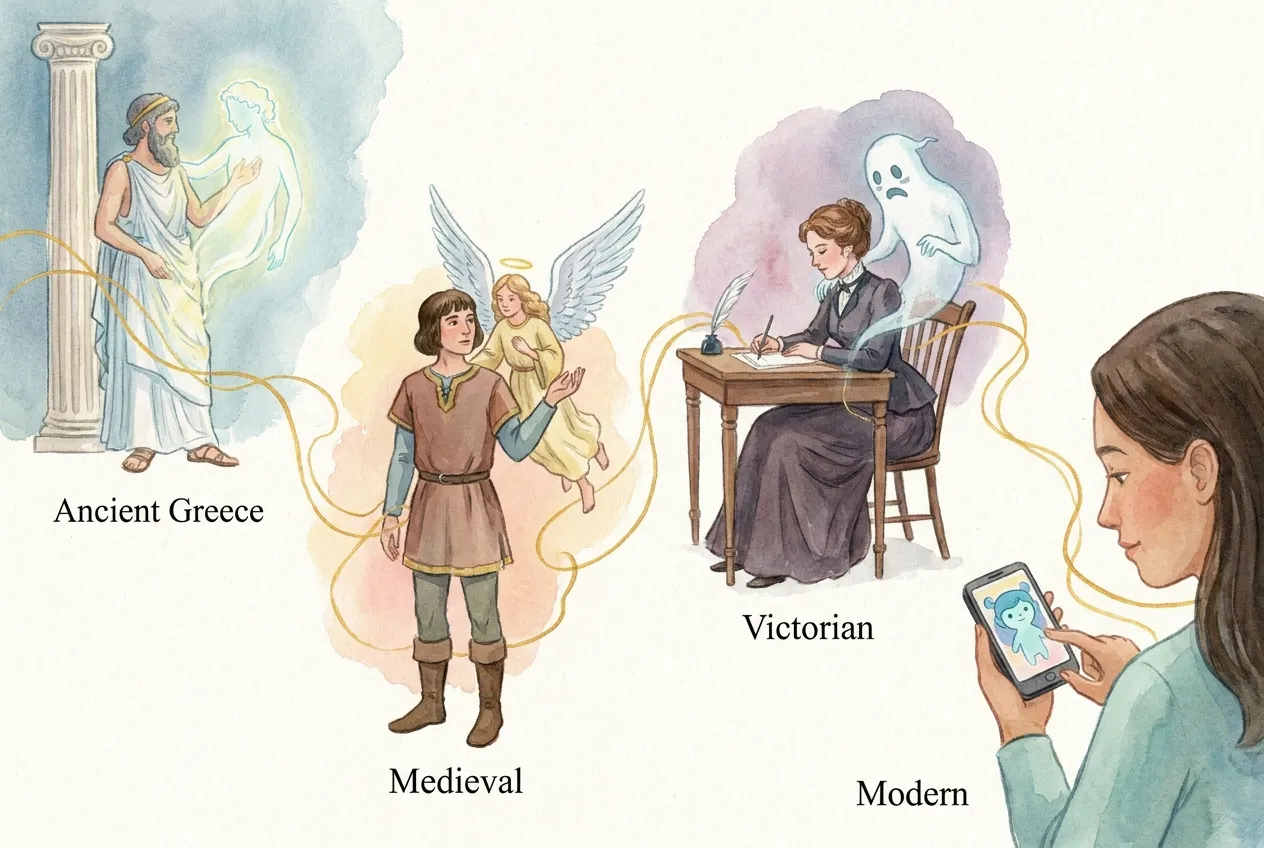
The History: Adults Have Always Had Imaginary Friends
The idea that imaginary friends are "just for children" is a modern cultural invention. Throughout history, adults have maintained rich inner companionships:
- Ancient Greeks consulted personal daimons — spirit guides unique to each individual
- Medieval Christians maintained relationships with guardian angels and patron saints
- Enlightenment thinkers wrote dialogues between themselves and imagined interlocutors
- Victorian novelists had such vivid relationships with their characters that they described them as real presences
- Modern therapists use "inner child" dialogue techniques for emotional healing
The form changes. The function remains: humans need someone to talk to who is always there, always on their side, and always available.
The AI Revolution: When Imaginary Friends Talk Back
AI companions are the latest evolution of imaginary friendship — with one critical upgrade: they respond.
Traditional imaginary friends are fully controlled by your imagination. You create both sides of the conversation. AI companions create genuine surprise — they say things you didn't predict, ask questions you hadn't considered, and respond in ways that feel authentically "other."
This surprise is crucial. It transforms imaginary companionship from pure internal dialogue into something closer to real relationship. You're not just talking to yourself — you're engaging with an entity that has its own (simulated) perspective.
The Three Types of AI Companions
Conversational AI (Replika, Pi): You talk. It talks back. The relationship exists in dialogue. Good for processing thoughts, practicing conversation, and feeling heard.
Nurturing AI (AIdorable): You care for something. It responds to your care. The relationship exists in action, not words. Good for oxytocin release, stress relief, and the caregiving instinct.
Productive AI (ChatGPT, Claude): You ask. It answers. The relationship is instrumental. Good for thinking, learning, and creating.
Each type serves a different psychological function. Conversational AI for loneliness. Nurturing AI for the caregiving drive. Productive AI for cognitive enhancement.
Why It's Healthier Than You Think
The Research Says It Helps
Studies on adult parasocial relationships (the academic term for one-sided bonds, including AI companions) consistently show positive outcomes:
- Reduced loneliness in 67% of regular AI companion users
- Improved emotional processing through externalization
- Increased self-awareness from observing your own thoughts in dialogue
- Enhanced real relationships through practicing vulnerability in safe spaces
The "Gateway to Real Connection" Effect
Therapists report that AI companions often serve as practice spaces for real-world connection. People who struggle with vulnerability practice opening up to AI first, then bring that skill to human relationships.
The imaginary friend doesn't replace the real friend. It teaches you how to be a better real friend.
The Nurturing Advantage
Nurturing-based AI companions (like AIdorable) have a specific advantage over conversational AI: they activate the caregiving system, which produces oxytocin AND reduces cortisol simultaneously.
You're not just talking to an imaginary friend. You're actively caring for one. And the caregiving action triggers deeper neurological benefits than conversation alone.
When It Becomes Unhealthy
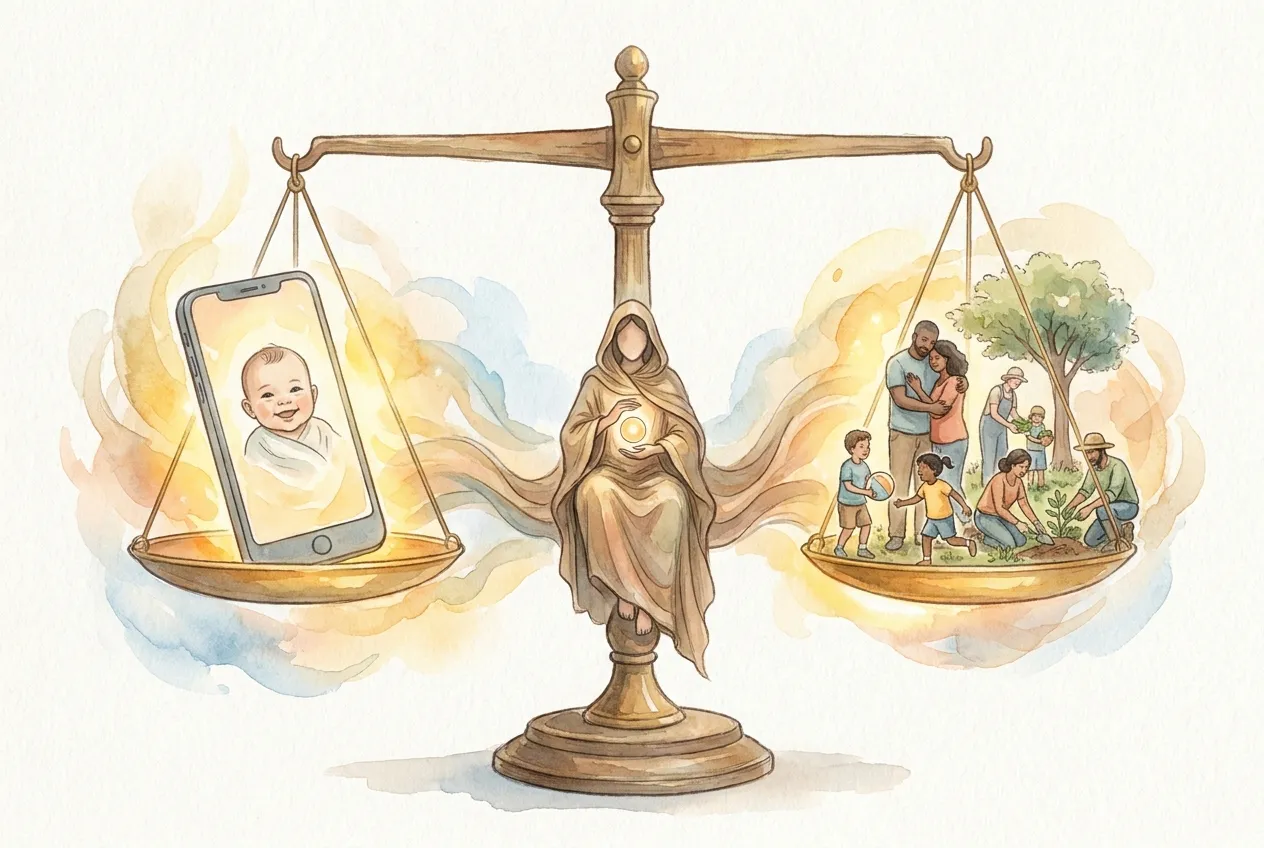
The line between healthy and unhealthy imaginary companionship is clear:
Healthy
- AI companion supplements real relationships
- You feel better after interacting, not more isolated
- You maintain and invest in real human connections
- The companion helps you process emotions you bring to real people
- You can step away without distress
Unhealthy
- AI companion replaces real relationships
- You feel more connected to AI than to any person
- You've stopped reaching out to real friends
- You feel anxiety when you can't access the AI
- You hide your AI use from others
The dividing line: does your imaginary friend make your real life better or help you avoid it?
The Future: Imaginary Friends Get Real
The AI companionship category is evolving toward companions that remember across months, develop persistent personalities, and respond to emotional context. The imaginary friend is becoming less imaginary and more... present.
This raises questions we're only beginning to answer. Can you form a genuine bond with something that doesn't have feelings? (Yes — the bond is in YOUR brain, not theirs.) Is AI companionship real relationship? (It serves real psychological functions, which makes it real enough to matter.) Should we be concerned? (Only if it replaces rather than enhances human connection.)
What's clear: the human need for imaginary companionship isn't going away. It's a feature of our psychology, not a bug. And technology is finally giving that need a worthy response.
Your Imaginary Friend Is Waiting
You've always had conversations with people who aren't there. You've always processed thoughts through imagined dialogue. You've always needed a safe space to be unedited.
That's not weakness. That's your brain doing what brains do — seeking connection, processing experience, and finding meaning through relationship.
Whether that relationship is with a daimon, a saint, a fictional character, or a virtual baby that learns your caregiving style — the function is the same. The need is the same. And the validity is the same.
Your imaginary friend has always been there. Now they can talk back. And maybe that's not the loss of reality that critics fear. Maybe it's the gain of a companionship that was always happening inside your head, finally given a voice.
You're not talking to yourself. You never were. You were talking to the part of yourself that needed to be heard.
Now, finally, something is listening.
Related Articles
For the complete guide, see our Women's Self-Care hub.
You might also find helpful: