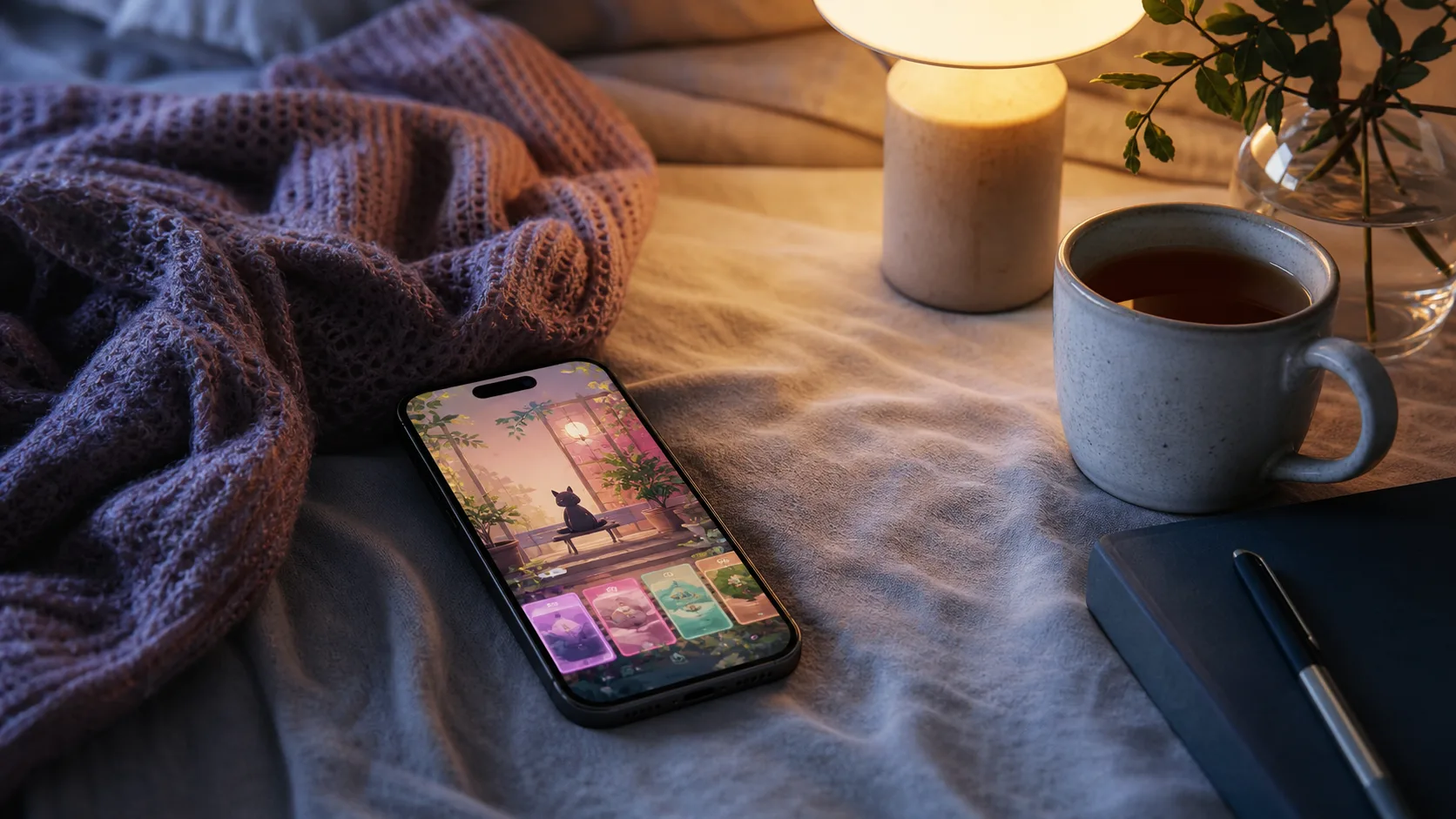
Self-Care Pet App Guide: The Quick Answer
Maybe you are not looking for a full mental health system. Maybe you just want an app that makes drinking water, journaling, or taking one deep breath feel less lonely.
That is the emotional hook behind a self-care pet app: what if taking care of yourself felt like taking care of something cute?
The format already has proof. The Finch app listing on Google Play describes Finch as a self-care pet app and shows 10M+ downloads. Its App Store page frames the product around a daily journal, habit tracker, breathing, reflection, and a customizable companion.
The best self-care tools do not make care feel like homework. They make the next small action feel emotionally possible.
In brief: these apps work because they turn a routine into a relationship.
What Counts as a Self-Care Pet App?
A self-care pet app is a wellness or mental health support tool where you care for a virtual pet while completing small actions.
Common features include:
- mood tracking and check-ins
- journaling or reflection prompts
- breathing exercises, mindfulness, or meditation
- habit goals, daily tasks, and reminders
- hydration, sleep, fitness, or calm routines
- rewards, outfits, rooms, travel, or companion growth
The companion is the difference. A normal tracker asks you to complete a task. A care-based loop says: show up once, and this little character responds.
The Core Care Loop
| Step | What happens | Why it helps |
|---|---|---|
| Check in | You name a mood or choose one easy goal | lowers friction |
| Care | The companion reacts to your action | adds emotional feedback |
| Reward | You earn growth, comfort, items, or continuity | reinforces return behavior |
| Repeat | The ritual becomes familiar | supports daily life |

Best Self-Care Pet Apps by Need
| Need | Best fit | Why |
|---|---|---|
| habit tracking | Finch | goals, rewards, and a pet bird |
| nurturing | AIdorable | a tiny AI baby companion care loop |
| mood tracking | Finch, Daylio, DailyBean | patterns and insight |
| mindfulness | Calm, Headspace, Kinder World | slower reflection and guided meditations |
| gamified productivity | Habitica | stronger task and reward mechanics |
| plant-based calm | Kinder World | quiet care without a busy checklist |
For a bottom-funnel comparison, read Apps Like Finch. For the broader soft wellness category, read Cute Self-Care Apps. For source-backed category data, read Virtual Pet Statistics 2026. For the bigger category, read the Digital Nurturing Companion Report 2026.

Finch App
Finch became the default example because it combines a Finch self care app experience with a virtual pet bird, mood check-ins, goals, quotes, journaling, guided breathing, and encouragement. Users can try a free version, earn rewards such as rainbow stones, customize the bird, and build a self-care routine on iOS or Android.
That mix is why people search for the Finch self-care app, using Finch, FinchApp content on TikTok or Instagram, and apps like Finch. It is not only a tracker. It is a pet bird that makes completing self-care feel softer.
AIdorable
AIdorable fits the softer edge of the same category. It is a virtual baby AI companion app for adults who want nurturing instead of another productivity system.
Finch says: take care of yourself so your bird can grow.
AIdorable says: care for something tiny, and let that care soften you too.
That makes AIdorable a better fit when the real feeling is personal or emotional:
- I want something small to care for.
- I want baby-fever comfort without a real-life decision.
- I want encouragement, not pressure.
- I want a ritual that feels feminine, cute, and warm.
For the baby-specific search, read Best Virtual Baby App.
Kinder World, Calm, and Mood Trackers
Kinder World uses plant care, kindness, and mindful reflection. Calm and Headspace focus more directly on meditation, sleep, and relaxation. Mood trackers are useful when you want insight into sleep, stress, productivity, hydration, chores, or daily life.
These options may be better if a heavily gamified loop feels too busy. A good app should encourage healthier behavior without making missed consecutive days feel like neglect.
Are Self-Care Pet Apps Good for Mental Health?
They can support mental well-being, but the wording matters.
Digital mental health research covers many tools: guided self-help, mood tracking, mindfulness exercises, CBT-based programs, and supportive apps. A 2025 PLOS Digital Health review included Finch among examples of digital mental health interventions, but that does not mean every cute companion is therapy.
A safer statement:
- they can make check-ins feel less clinical
- they can support reflection and journaling
- they can help some people meditate or relax
- they can make daily tasks feel more rewarding
- they should not replace counseling, crisis support, or medical care
This boundary matters for AIdorable too. It is a nurturing comfort ritual, not a treatment product for a disorder.
Children, Privacy, and Download Checks
Some apps are rated for broad audiences, but that does not make every companion product children's software. Before you download one, check:
- age rating and parent guidance
- privacy label or data safety section
- social features, AI chat, ads, and purchases
- whether the developer explains data deletion
- whether the tone still feels kind after the first week
For AIdorable specifically, the positioning is adult-focused.
How to Choose the Best App
Use one simple question: what do I need this ritual to do for me?
If you need structure, choose goals, reminders, and rewards. If you need calm, choose breathing, guided meditations, or a slower plant loop. If you need warmth, choose a companion-first ritual.
My practical recommendation is small:
- Open the app once.
- Do one check-in.
- Pick one easy goal.
- Care for the companion.
- Close it while you still feel calm.
That keeps the tool in its proper place. It becomes a doorway into care, not another authority in your pocket.
Finch App Terms and Feature Checklist
Use this checklist when comparing a self-care pet app, especially if you are deciding whether the Finch self care style is right for you.
| Feature or term | What it means | Why it matters |
|---|---|---|
| free version | a way to try the loop before paying | pricing should not hide behind cuteness |
| Finch Plus | paid extras inside Finch | useful only if the core loop already helps |
| mood tracker | check-ins and mood trends | gives insight without needing a full journal |
| breathing exercises | short guided pauses | helps you relax before the next task |
| rainbow stones | in-app reward currency | makes completion feel playful |
| streak or consecutive days | repeated use over time | can motivate, but can also create pressure |
| easy goals | small actions such as "get out of bed" or "drink water" | keeps self-care from feeling too big |
The healthiest version is curated. Use the app for motivation, encouragement, reflection, and reinforcement, but keep the routine small enough that self-care does not become a chore.
Common Search Questions
People often ask: What is Finch app? Could you suggest a nice virtual pet/self-help game? Is self care a chore? Do these apps help improve mental health?
The short answer is that a mindful companion can help some people feel prepared and positive, especially when the loop includes quick mood checks, journaling, mindful breathing exercises, and simple daily tasks. It is still a useful tool, not a replacement for support from real people or professionals.
Sources
- Finch on Google Play
- Finch on the App Store
- Bandai Tamagotchi 100 million shipment announcement
- PLOS Digital Health review of digital mental health interventions
Conclusion
The best self-care pet app is not automatically the one with the most features.
It is the one you actually return to.
For some people, that is Finch: the bird, the goals, the rewards, the mood tracker, and the sense that self-care can be lightweight. For others, it is something quieter: a journal, a plant, a digital pet, a calm routine, or an AI baby companion.
If you want structure, choose the app that helps you complete the next task. If you want softness, choose the app that makes care feel emotionally safe. And if what you really want is a tiny being to care for at the end of a long day, AIdorable was built for exactly that feeling.