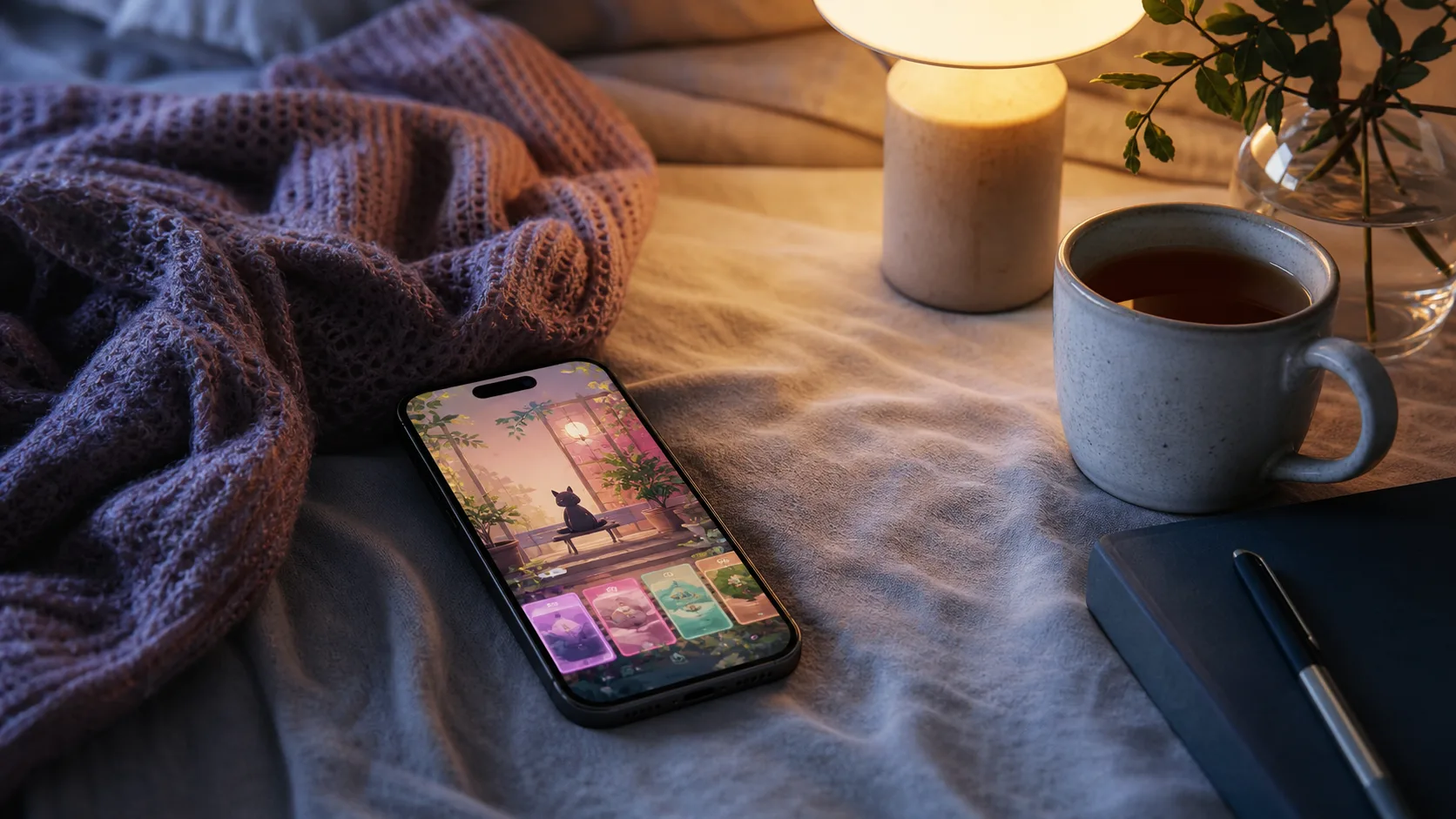
Cute Self-Care Apps: The Quick Answer
What if a self-care app did not feel like homework?
That is the whole appeal of cute self-care apps. They turn a tiny action - checking your mood, opening a journal, drinking water, breathing for one minute, or caring for a digital companion - into something softer than another productivity dashboard.
The factual reason this category matters is simple: Finch has become a major example of the format. Its Google Play listing describes Finch as a self-care pet app and shows 10M+ downloads. Daylio's Google Play listing also shows 10M+ downloads for its private mood tracker and journal. Calm shows 50M+ downloads for meditation and sleep. Insight Timer, Headspace, Day One, Colorfy, and Lumosity show how broad the category has become: meditation, journaling, coloring, puzzles, mood tracking, and mental wellness can all sit under the same self-care umbrella.
The best self-care app is not the one that makes you optimize harder. It is the one you can open on a low-energy day and still feel welcomed by.
Personally, this is the line I would use: a cute app should make care feel emotionally possible. If it makes you feel guilty, pressured, watched, or behind, the design may be pretty, but the ritual is wrong.
What Makes a Self-Care App Cute?
A cute self-care app usually combines wellness tools with a visual emotional hook. That hook might be a pet, plant, avatar, cozy world, mood icon, soft color palette, friendly prompt, or tiny companion.
Common features include:
- mood tracking with icons, colors, or beans
- journaling prompts that feel low-pressure
- meditation or guided breathing
- habit tracker goals and reminders
- cozy games, rooms, outfits, pets, or collectibles
- kindness prompts, affirmations, or reflection cards
- a virtual pet, plant, or AI companion that grows over time
The core difference is tone. A normal tracker says: complete the task. A cute self-care app says: come back gently.
Cute Does Not Mean Shallow
Cute design can reduce friction. It can make a difficult day feel a little less sterile. It can help a user start without needing a big plan.
But cute design can also hide pressure. Streaks, badges, notifications, and subscriptions still need to be judged honestly. The best app is the one that supports your actual nervous system, not just the one with the prettiest mascot.
Best Cute Self-Care Apps by Need
| Need | Best fit | Why it works |
|---|---|---|
| self-care pet | Finch | virtual pet care, goals, journaling, and breathing |
| nurturing ritual | AIdorable | tiny AI baby care loop for adults |
| mood tracking | Daylio | low-friction mood journal and private tracking |
| gamified habits | Habitica | RPG tasks, rewards, parties, and pets |
| meditation | Calm, Headspace, or Insight Timer | guided meditations, sleep, breathing, mindfulness |
| journaling app | Day One or a notes app | private writing, reflection, and memory keeping |
| coloring and puzzles | Colorfy or Lumosity | creative breaks and brain-training style play |
| plant-based softness | Kinder World | emotional wellbeing and kindness through plant care |
| emotional creatures | Voidpet Garden | feelings represented through collectible companions |
For a tighter Finch-style breakdown, read the Self-Care Pet App Guide. For bottom-funnel comparison, read Apps Like Finch. For the baby-care branch of the category, read the Baby Simulator App Guide. For the bigger category, see the Digital Nurturing Companion Report 2026.

How to Choose the Best Self-Care App
Start with the emotional job, not the feature list.
If You Need Structure
Choose a habit tracker or gamified app. Finch and Habitica are strong here because they make daily self-care visible. Habitica is more game-like, while Finch is softer and companion-led.
Use this lane if you want:
- repeated daily goals
- reminders
- progress feedback
- streaks or rewards
- a sense of "I did the thing"
If You Need Insight
Choose a mood tracker or journaling app. Daylio works because it lets users track mood and activities with very little writing. A guided journal can help if you need to name your thoughts and feelings more directly.
Use this lane if you want:
- mood patterns
- gentle reflection
- simple notes
- private journaling
- less noise than a full wellness platform
If You Need Calm or Mindfulness
Choose meditation apps such as Calm, Headspace, or Insight Timer. This lane is better when you want guided meditations, breathing exercises, sleep stories, mindfulness content, or simple meditation techniques.
Use this lane if the feeling is physical: tense shoulders, racing thoughts, bad sleep, or a need to slow down.
If You Need a Journaling App
Choose Daylio, Day One, a guided journal, or even a private notes app if the main job is naming your thoughts and feelings. A good journaling app should make the prompt feel optional, not like a worksheet.
Use this lane if you want to track your mood, reflect on a hard day, keep tiny memories, or build a daily self-care habit without a complicated dashboard.
If You Need Something to Care For
Choose a care-loop app. This is where Finch, Kinder World, Voidpet Garden, virtual pets, and AIdorable fit.
AIdorable is the softest fit when the real need is nurturing. It is a virtual baby AI companion app for adults who want a cute, nurturing self-care ritual. You adopt, name, check on, feed, soothe, and care for a tiny AI baby who grows through daily interactions.
That makes it different from a productivity app. AIdorable does not start with "what did you complete?" It starts with "who are you caring for?"
Free Self-Care Apps: What to Check First
Many wellness apps are free to download, but the free version may not include every feature. Before you build your routine around any app, check:
- what is free versus paid
- whether there are ads
- whether subscriptions renew automatically
- whether data can be exported or deleted
- privacy labels and data safety sections
- age rating and audience positioning
- whether missed days create pressure
- whether the app is a general wellness app, a mental health app, or a game
This matters because self-care should not become another source of stress. A beautiful app can still be the wrong fit if the free version is too limited or the notification style feels demanding.
Some free apps are better used as a first step than a whole system. Insight Timer can help with a guided meditation, Colorfy can give you a calm coloring break, Lumosity lets you play games and puzzles, Day One can hold private reflections, and a simple notes app can be enough if all you need is a prompt and a quiet place to write.
Mental Health App Boundaries
Cute self-care can support mental wellness, but not every self-care app is a clinical mental health app. Be careful with apps that imply they can diagnose, treat, or replace care from a professional.
Some apps use techniques inspired by cognitive behavioral therapy, meditation, grounding, or emotional check-ins. That can be useful for everyday stress. It should still be framed honestly: self-care apps can help you practice self-care, notice patterns, build healthy habits, and return to yourself, but crisis care belongs with qualified human support.
Cute Self-Care App Comparison
| App | Cute element | Best app for | Watch out for |
|---|---|---|---|
| AIdorable | tiny AI baby companion | nurturing and emotional softness | use as comfort, not crisis care |
| Finch | self-care pet bird | habits, journaling, mood check-ins | streak pressure for some users |
| Daylio | icons and mood colors | simple mood tracking | less relational than pet apps |
| Habitica | RPG avatar, gear, pets | gamified productivity | can feel too task-heavy |
| Calm | soothing audio world | meditation and sleep | subscription depth varies |
| Headspace | friendly mindfulness design | meditation and mental wellness tools | broad platform may feel busy |
| Insight Timer | meditation library | guided meditations and mindfulness | choice overload for some users |
| Day One | clean writing space | journaling and memory keeping | less cute, more classic journal |
| Colorfy | coloring pages | creative decompression | coloring may not be enough structure |
| Lumosity | puzzles and games | playful brain-training breaks | more mind game than emotional care |
| Kinder World | plant care | gentle emotional wellbeing | slower pace, less data-driven |
| Voidpet Garden | emotional creatures | symbolic mood care | may not fit users who want structure |

A Gentle Daily Routine
The healthiest routine is small enough to repeat.
Try this:
- Open the app.
- Choose one mood or feeling.
- Do one tiny action.
- Care for the companion, plant, pet, or avatar.
- Close the app before it turns into scrolling.
That last step matters. The app should return you to your life, not pull you deeper into your phone.
AIdorable's Place in the Cluster
AIdorable belongs in the cute self-care category, but it is not just another tracker. It sits between:
- a self-care pet app
- a virtual baby app
- a non-romantic AI companion
- a soft daily check-in
- a cozy character-led ritual
That is why it links naturally with virtual baby apps, apps like Finch, self-care pet apps, and the broader AI companion app statistics page.
Key Takeaways
- Cute self-care apps are useful when they make small care actions feel easier to start.
- Finch is the clearest self-care pet example, with habit tracking, mood journaling, breathing, and a virtual pet.
- Daylio is better for mood tracking and private journaling.
- Calm, Headspace, and Insight Timer are better for meditation, sleep, and guided mindfulness.
- Habitica is better for users who genuinely like gamified tasks.
- Day One or a notes app can be enough if the real need is private journaling.
- Colorfy and Lumosity are more playful free apps for creative or puzzle-based breaks.
- AIdorable is the softer choice when the emotional need is nurturing, not productivity.
- Cute design is only healthy if the app still respects privacy, boundaries, and low-pressure use.
Sources
- Finch on Google Play
- Finch on the App Store
- Daylio on Google Play
- Daylio on the App Store
- Habitica official site
- Calm on Google Play
- Headspace on Google Play
- Insight Timer official site
- Day One official site
- Colorfy on Google Play
- Lumosity official site
- Kinder World official site
- Voidpet Garden official site
Conclusion
The best cute self-care app is not automatically the most popular app or the prettiest one.
It is the one that helps you come back to yourself without shame.
For some people, that is Finch: a bird, a goal, a tiny win. For others, it is Daylio: a private mood tracker with simple icons. For others, it is Calm, Headspace, Habitica, Kinder World, or Voidpet Garden.
And for women who want self-care to feel less like self-improvement and more like tenderness, AIdorable is built around a different kind of ritual: caring for a tiny AI baby, one soft check-in at a time.