When a Mental Health App Starts Feeling Like One More Thing
You open your phone because your chest feels tight. Your mind is moving too fast. You want something that will help, but the app store gives you a wall of choices: meditation, CBT, journaling, mood tracking, breathing, habit streaks, sleep sounds, therapy chat, wellness coaching.
That is a lot to sort through when your nervous system is already tired.
The best self care app for anxiety is not always the mental health app with the longest feature list. Often, the best mental health app is the one that asks the least from you in the moment. It gives you a small next step. It does not scold you. It does not turn calm into homework. It helps your body, your thoughts, or your heart settle enough to come back to yourself.
For the broader self-care landscape, start with our self care apps guide. This page is narrower: what to choose when anxiety is the main problem.
Quick Match: Which Mental Health App Style Fits Your Anxiety?
| Anxiety moment | Best app type | What to look for |
|---|---|---|
| Tight chest, shallow breathing, panic wave | Breathing or grounding mental health app | One-tap breathing exercises, short timers, no setup |
| Spiraling thoughts, catastrophic thinking | CBT or cognitive behavioral therapy app | Thought reframing, worry records, gentle prompts |
| Overwhelm from too many feelings | Journaling wellness app | Specific questions, voice notes, low-pressure entries |
| Restless body before sleep | Meditation app or mindfulness apps | Guided meditation, body scans, calm narration |
| Anxiety mixed with loneliness | Nurturing or companion app | Warm anxiety support, emotional support, care-based interaction |
| Anxiety from chaos and inconsistency | Habit or routine app | Tiny goals, flexible reminders, no streak shame |
If you are not sure, start with the body. Anxiety often feels mental, but it usually arrives through the body first: breath, jaw, shoulders, stomach, heart rate. A good anxiety self care app should help you downshift before it asks you to analyze anything. The best apps for anxiety usually make the first step obvious: breathe, name the thought, write one sentence, or connect with something calming.
This is also why "mental health app" is too broad a search by itself. Some mental health apps are built for anxiety management. Some mental health apps focus on anxiety and depression together. Some apps for mental health are mostly education libraries. Some wellness apps can help users build a daily routine, but they do not always help with anxiety in the moment.
1. AIdorable: Best Mental Health App Style for Anxiety Mixed With Loneliness
AIdorable is different from most apps for anxiety because it does not start by asking you to track, label, or fix yourself.
It gives you someone tiny to care for.
That matters when anxiety is not just a symptom, but a loneliness pattern. Maybe you are technically fine. Maybe you have a job, a schedule, people who know you. But at night, the feeling still comes: nobody really needs you, nothing feels soft, and your phone is full of stimulation but not comfort.
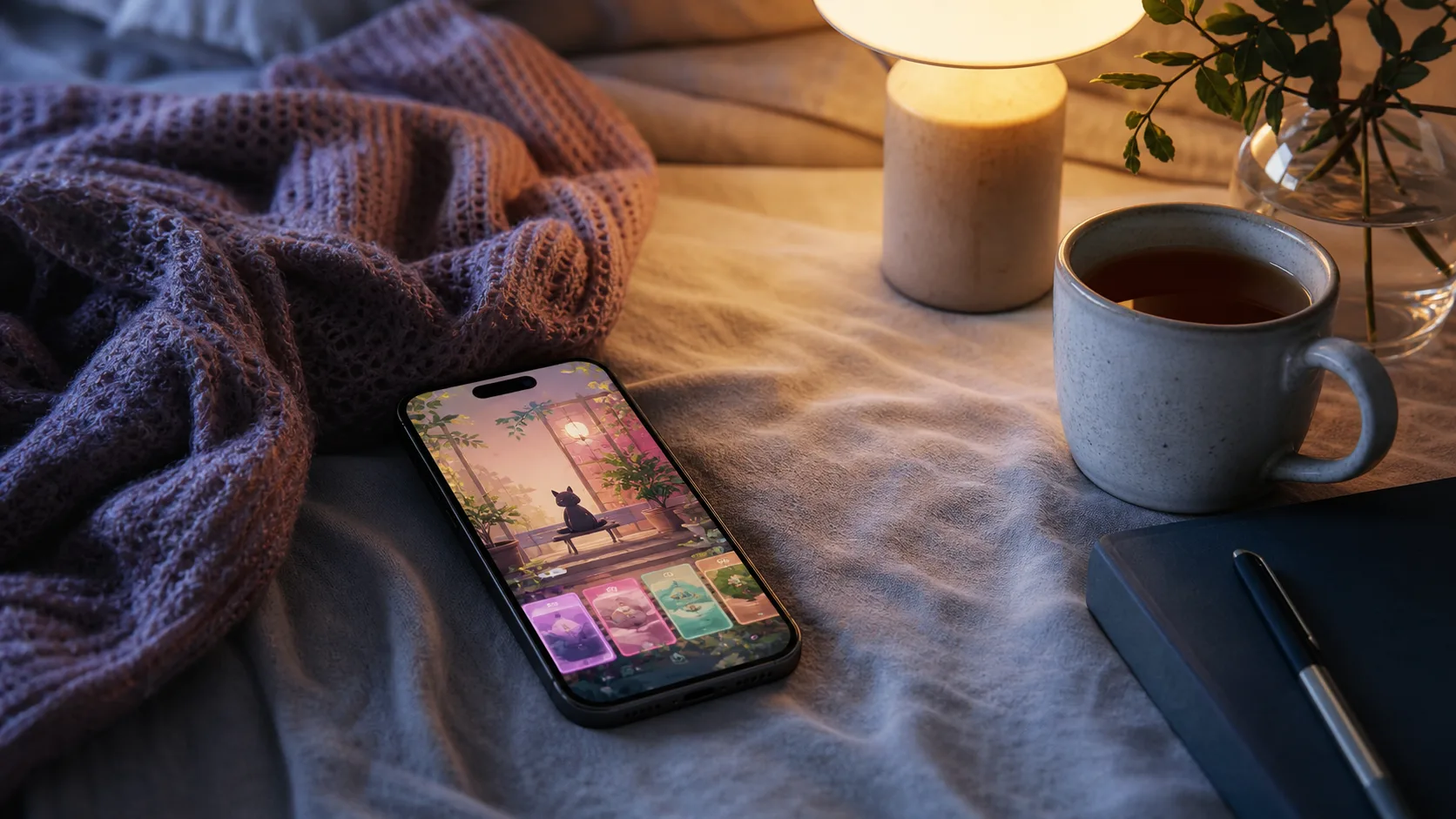
AIdorable turns self care into a small nurturing ritual. You check in. You feed your baby. You soothe her. You watch her grow because you showed up.
Why it helps anxiety: nurturing can move attention out of the spiral and into a concrete, gentle action. Instead of asking, "What is wrong with me?" the app gives you a softer question: "What does she need right now?" For stress and anxiety, that kind of emotional redirection can feel more accessible than a workbook.
That shift can be surprisingly regulating.
Use AIdorable if your anxiety is tangled with:
- Loneliness and wanting a warm daily connection
- Burnout where traditional self care feels like another performance
- The need to feel needed without taking on a real-life obligation
- Emotional numbness where meditation feels too blank or quiet
- Night anxiety when you want a calming ritual that is not doomscrolling
This is not clinical treatment. It is not a replacement for therapy, medication, crisis care, a mental health professional, or a real support system. If you are dealing with anxiety disorders, unsafe thoughts, severe anxiety and depression, or health conditions that affect your daily life, professional care matters. But as a daily self care app, AIdorable gives anxiety something many tools miss: emotional warmth.
The most useful anxiety app is not always the one that explains your feelings. Sometimes it is the one that gives your feelings somewhere gentle to go.

2. CBT Apps: Best for Spiraling Thoughts
CBT apps are useful when anxiety takes the shape of thoughts. CBT stands for cognitive behavioral therapy, and a CBT mental health app can help you notice how thoughts, feelings, and behavior feed each other:
- "What if I mess this up?"
- "Everyone is annoyed with me."
- "Something bad is going to happen."
- "I should have handled that better."
The best CBT apps help you catch the thought, name the distortion, and write a more balanced version. That sounds simple, but when you are anxious, your brain treats every worry like evidence. A structured cognitive behavioral prompt can slow the loop down.
Look for features like:
- Thought records
- Cognitive distortion labels
- Worry time
- Behavioral experiments
- Simple mood check-ins
- Crisis resources and clear boundaries
- Health resources that point toward professional care when needed
CBT is especially helpful if your anxiety is verbal and repetitive. It is less helpful when you are too activated to think clearly. In those moments, do a breathing or grounding exercise first, then come back to the thought work.
MindShift is one example of a CBT-style anxiety support app people often encounter in this category. You do not have to choose MindShift specifically, but the mental health app category is useful: look for anxiety management tools that help users reframe worries without making the interface feel clinical or punitive.
3. Breathing Apps: Best for Physical Stress and Anxiety
If anxiety shows up as a racing heart, tight chest, dizziness, stomach drop, or shaky hands, a breathing app may help faster than a journal. For many people, breathing exercises are the simplest stress management tool because they meet anxiety in the body.
The key is simplicity. You should not have to create an account, choose a course, set goals, or read five screens of education while your body is already alarmed.
Good breathing apps offer:
- A one-tap start button
- Visual pacing
- Short sessions under three minutes
- Box breathing or extended exhale options
- Haptics or gentle sound
- No aggressive streak reminders
Try this two-minute pattern: inhale for four, exhale for six, repeat ten times. Longer exhales tell the body that danger is passing. It will not solve every anxiety trigger, but it can lower the intensity enough to make your next choice easier.
This is where the right app can help most quickly. You are not trying to manage anxiety forever in one session. You are trying to manage stress for the next two minutes, then choose the next tiny step.
For more immediate grounding ideas, see how to calm down.
4. Journaling Apps: Best When You Need to Unload
Journaling helps when anxiety is tangled, vague, or emotionally crowded. The problem is that blank pages can feel hostile when you are overwhelmed.
Choose a journaling app with specific prompts instead of a big empty text box. Voice notes can also help because talking is often easier than typing when you are keyed up.
Helpful anxiety prompts include:
- What am I afraid will happen?
- What do I know for sure?
- What is one thing I can do in the next ten minutes?
- What would I tell a friend who felt this?
- What feeling is underneath the worry?
Journaling works best when it reduces pressure. If the app starts making you feel like you need perfect reflections, perfect mood logs, or perfect insights, it has drifted away from self care.
For anxiety management, the best journaling mental health apps offer short prompts, not essays. A free version is enough if it lets you capture one worry, one fact, and one next action. You do not need a premium dashboard to start managing your mental health with one honest sentence.

What Mental Health Apps Get Wrong
Many wellness apps are designed for a calm person planning a better life. Apps for anxiety need to be designed for a dysregulated person trying to get through the next five minutes.
That difference changes everything.
Too many choices can make anxiety worse. If the home screen has courses, badges, graphs, communities, challenges, articles, and a premium upsell, the app may be too demanding for acute anxiety.
Streaks can backfire. Streaks motivate some people, but they can also turn self care into a pass/fail system. Missing a day should not make you feel like you ruined your healing.
Tracking is not the same as relief. Mood tracking can reveal patterns, but it does not automatically soothe you. If you log anxiety every day and still feel alone with it, you may need a more experiential tool.
Clinical language can feel cold. Evidence-based tools matter. But if an app feels sterile, it may not help the emotional part of anxiety: the part that wants reassurance, warmth, and safety.
The right self care app for anxiety should meet you where you are, not where an idealized productive version of you is supposed to be.
The best mental health apps offer clarity without coldness. They give mental health support, but they also respect the fact that people with anxiety are tired. They include health resources, but they do not pretend an app can replace professional care. They support mental wellness without turning mental wellness into a personal branding project.
When Mental Health Apps Actually Work
Mental health apps actually work best when they match one narrow job. The apps actually work when a breathing tool lowers your body alarm, a CBT prompt catches one distorted thought, a guided meditation helps you sleep, or a nurturing ritual gives you enough comfort to stop spiraling.
Mental health apps may disappoint when they promise a total life reset. Anxiety support does not need to be grand. The best mental health app for an anxious day is often the smallest one you can use without arguing with yourself.
A Simple Anxiety Self Care Daily Routine
You do not need a complicated mental health stack. Start with a routine small enough that you can do it on a bad day.
Morning: choose one anchor.
Open one app and do one thing: breathe for two minutes, check in with your baby on AIdorable, write one sentence, or choose a single intention. The point is not productivity. The point is telling your nervous system, "We are not starting the day in free fall."
Midday: interrupt the spiral.
When anxiety rises, do not ask yourself to understand your whole life. Ask, "Body, thoughts, or heart?" If it is body, breathe. If it is thoughts, use CBT. If it is heart, choose connection or nurturing.
Evening: close the loop.
End with something soft. A sleep story, a body scan, a quick journal entry, or a nurturing check-in. Your phone can either keep the alarm going or become part of the downshift.
This is why AIdorable fits so naturally into anxiety self care. It does not require you to become calm before opening it. It gives you a gentle action that can lead you there.
You can pair that with more clinical apps for mental health if you need them. A CBT app can help with anxiety thoughts. Mindfulness apps can help with long-term attention. A meditation app can help with sleep. A nurturing app can help when the anxious part of you needs comfort before insight.
Best Apps for Anxiety: A Plain-English Decision List
There is no single best mental health app for every person. A better question is: what do you need the app to do first?
Choose a CBT mental health app when your anxiety is repetitive, verbal, and full of predictions. Cognitive behavioral therapy tools are especially useful for thought spirals, social anxiety worries, and "what if" loops.
Choose a breathing app when anxiety feels physical. Breathing exercises, grounding, and relaxation tools can help users calm the body before trying to think.
Choose mindfulness apps when you want practice over time. Meditation and mindfulness can support mental wellness, but they are often harder during acute anxiety. Start with short guided meditation instead of long silent sessions.
Choose a journaling wellness app when you need emotional sorting. It can help with anxiety and depression patterns when paired with therapy, support, or professional care.
Choose AIdorable when anxiety support needs to feel warm, not clinical. It is not a medical mental health app, but it can help with anxiety that is connected to loneliness, emptiness, burnout, or the need for a gentle daily routine.
The cleanest setup is usually one primary app and one backup: a warm daily self-care app for emotional support, plus one of the simple stress management apps for breathing or CBT when anxiety spikes.
When to Choose Each Type of App
Choose a CBT app if your anxiety is mostly thought spirals and you like structured exercises.
Choose a breathing app if your anxiety is physical, sudden, or panic-like.
Choose a meditation app if you want long-term practice and can tolerate stillness.
Choose a journaling app if your feelings need language before they can settle.
Choose a mood tracker if you want to understand patterns over weeks.
Choose AIdorable if your anxiety is mixed with loneliness, emotional emptiness, burnout, or the ache of wanting something gentle to care for.
These tools can work together. A breathing app can calm the body. A CBT app can reframe the thought. AIdorable can give the heart a softer place to land.
For adjacent options, compare calming apps, games for anxiety, and mental health companion apps.
If you are comparing apps to help you cope, ignore the fanciest screenshots for a minute. Ask whether the app can help you in the exact moment anxiety usually arrives. If anxiety hits at night, prioritize sleep, guided meditation, nurturing, or relaxation. If anxiety hits at work, prioritize one-minute breathing exercises or CBT prompts. If anxiety hits when you feel alone, prioritize connection and anxiety support.

The Real Test: Do You Feel Better After Opening It?
Anxiety can make you outsource trust to rankings, reviews, and feature lists. But your body gives better feedback.
After using a self care app for a week, ask:
- Do I feel calmer, warmer, or more grounded after opening it?
- Is it easy to use when I am anxious?
- Does it reduce shame?
- Does it make my day simpler?
- Do I return because it helps, not because I feel guilty?
If the answer is no, the app may be good software but the wrong support.
The goal is not to build the perfect wellness system. The goal is to create a tiny reliable bridge from anxious to okay. Some days that bridge is one breath. Some days it is one sentence. Some days it is feeding a virtual baby and feeling your shoulders drop because something sweet is still here.
That counts.
Conclusion: Pick the Mental Health App That Lowers the Load
The best self care app for anxiety is not the most ambitious one. It is the mental health app, wellness app, or nurturing routine you can actually open when you feel messy, tired, scared, or alone.
If you need thought support, use CBT. If you need body support, use breathing exercises. If you need long-term mental wellness support, try mindfulness, guided meditation, or a meditation app. If you need emotional support, choose something warm enough to reach the part of you that tracking cannot touch.
AIdorable belongs in that last category. It is self care through nurturing: small, repeatable, emotionally specific, and gentle enough for anxious days.
Open AIdorable and try a softer self care ritual.
Related Articles
For the complete framework, see our women's self-care guide.
You might also find helpful: