Some days you want a deep story. Some days you need ten quiet minutes, one tiny win, and absolutely nobody yelling through a headset.
That is where mood boosting games shine. The right game can give your brain a friendly place to focus, invite you to move, reconnect you with a friend, or help you complete one manageable task when the rest of the day feels too large.
The important word is right. A frantic competitive game may energize one player and exhaust another. A cozy farming simulator may feel comforting tonight and strangely demanding tomorrow. The best choice is not the game with the highest rating; it is the game that fits the emotion you have now.
Choose a Game for the Mood You Need
| If you need... | Try this kind of play | Good starting point |
|---|---|---|
| Calm | Gentle puzzles and soothing exploration | Dorfromantik or A Short Hike |
| A small win | Short levels with visible progress | Tetris Effect or Monument Valley |
| Connection | Cooperative or kind social play | Kind Words or Mario Kart with friends |
| Energy | Rhythm and movement | Just Dance |
| Comfort | Familiar routines and nurturing | Animal Crossing, Stardew Valley, or AIdorable |
| Creative release | Building, decorating, and arranging | Minecraft Creative or Unpacking |
Use this table as a mood menu, not another task to optimize. Pick one feeling you want a little more of and choose the easiest game to open.
Why Games Can Change How a Bad Day Feels
A game cannot solve every reason you feel low, but gameplay can change the texture of a difficult moment. It can narrow your attention from an overwhelming day to one clear challenge. It can offer immediate feedback, a safe place to experiment, and a visible sense of progress.
Different games create that mood boost in different ways:
- Focus: a puzzle gives wandering thoughts one manageable target.
- Agency: choosing, building, or caring for something restores a sense of influence.
- Mastery: completing a level creates a small experience of competence.
- Connection: cooperative and social games make play feel shared.
- Movement: rhythm games turn exercise into a playful activity.
- Emotion: music, color, story, and sound can gently shift the atmosphere around you.
Research on gaming and mental health is more nuanced than “games are good” or “games are bad.” The experience depends on the person, the reason for playing, the type of video game, and what happens before and after the session. Intentional play that leaves you more settled is different from hours of reflexive scrolling or gaming that pushes sleep, meals, responsibilities, and relationships aside.
A mood-boosting game does not have to make you wildly happy. Sometimes success is feeling 10% softer, steadier, or more willing to take the next step.
12 Best Mood Boosting Games for Different Kinds of Days
These are games to play to boost your mood across mobile, Nintendo Switch, console, and PC. If digital play feels tiring, a familiar board game with a friend can create the same mix of fun, cognitive challenge, and social connection. Even choosing a movement game instead of another YouTube video can turn passive screen time into light exercise.
1. Stardew Valley — for comforting routine
Best for: gentle structure, long-term progress, and a cozy world.
Stardew Valley mixes farming, fishing, decorating, exploration, and relationships into a routine you can shape yourself. Watering a few crops or tidying one corner of the farm provides a clear beginning and end, which can feel grounding when real life is messy.
The game does have a daily clock, so perfectionists may want to consciously ignore “optimal” play. Your farm does not need to be efficient to be enjoyable.
2. Animal Crossing: New Horizons — for familiar comfort
Best for: collecting, decorating, and low-stakes social connection.
Animal Crossing invites you to visit a bright island, talk to animal neighbors, catch bugs, and improve your home over time. Its real-time rhythm makes it feel like a familiar place rather than a level to beat.
It is especially pleasant when you want a positive routine without a hard challenge. Open it, find a fossil, change an outfit, and leave. That is enough.
3. Unpacking — for order without pressure
Best for: quiet focus and a satisfying sense of completion.
Unpacking turns moving boxes into a gentle puzzle. You place everyday objects in rooms while learning about a life through the things a person keeps. There are no enemies and little urgency; the pleasure comes from creating order.
If clutter makes your brain buzz, the clean visual progress can be soothing. It may even inspire one tiny real-world reset—though you never need to “earn” play by cleaning first.
4. Dorfromantik — for calm concentration
Best for: peaceful puzzles, landscapes, and easy stopping points.
In Dorfromantik, you place hexagonal tiles to build villages, forests, rivers, and fields. The rules offer enough challenge to engage the brain without turning every mistake into a crisis.
This is one of the strongest relaxing games for players who need focus rather than story. Its quiet visual design also makes it easier to play when your emotional bandwidth is low.
5. Tetris Effect: Connected — for a fast mental reset
Best for: immersive music, flow, and short sessions.
Tetris is a classic brain puzzle, but Tetris Effect surrounds its familiar blocks with responsive music and luminous environments. The combination of pattern recognition, sound, and movement can pull attention into the present.
Choose an easier mode if you are already stressed. The goal is a mood boost, not proving how much pressure you can tolerate.
6. A Short Hike — for lighthearted exploration
Best for: warmth, humor, and the feeling of getting outside.
A Short Hike lets you wander a small park, meet charming characters, climb, glide, fish, and explore at your own pace. It is compact enough to finish without becoming a month-long project, yet open enough to encourage curiosity.
Its playful world is a lovely choice when you feel stuck or burnt out and want an adventure that asks very little of you.
7. Kind Words — for gentle human connection
Best for: encouragement without the noise of traditional social media.
Kind Words centers on sending and receiving short supportive letters. The experience is limited and deliberately gentle: you can share a worry, respond kindly to another person, or collect stickers while listening to calm music.
Because it involves real people, keep personal details private and use the platform's safety tools. At its best, the game offers a reminder that strangers can be thoughtful too.
8. Mario Kart 8 Deluxe — for laughter with friends
Best for: playful competition and social energy.
Mario Kart is not quiet, but mood boosting does not always mean calm. A quick race with a friend can bring surprise, teasing, and shared laughter. Its familiar controls and chaotic items let less experienced players join the fun.
If competition reliably causes conflict, choose teams, lower the stakes, or play a cooperative game instead. Social play should leave the group closer, not sharper.
9. Just Dance — for movement and music
Best for: shaking off restless energy.
Sometimes the fastest emotional shift starts with the body. Just Dance turns music and exercise into a colorful game, giving you a reason to stand up without framing movement as punishment.
Try one favorite song rather than committing to a workout. A three-minute dance can still be a positive choice and may make the next activity feel easier.
10. Monument Valley — for beauty and manageable puzzles
Best for: visual calm and brief mobile play.
Monument Valley uses impossible architecture, soft color, and elegant touch puzzles. Its chapters are short, its challenge is approachable, and its world feels more like an illustrated dream than a demanding mobile game.
It works well when you want to engage your cognitive attention but do not have the energy for complex systems, combat, or a long tutorial.
11. Minecraft Creative Mode — for imagination without survival pressure
Best for: building, experimentation, and open-ended creativity.
Minecraft can be intense in Survival Mode, but Creative Mode removes resource scarcity and hostile pressure. You can build a garden, design a tiny house, recreate a memory, or simply fly until you find a landscape that inspires you.
Open-ended games are ideal when expression feels good. If a blank world feels overwhelming, set a tiny challenge: build one cheerful room using only five materials.
12. AIdorable — for a nurturing two-minute ritual
Best for: caring, emotional continuity, and gentle daily connection.
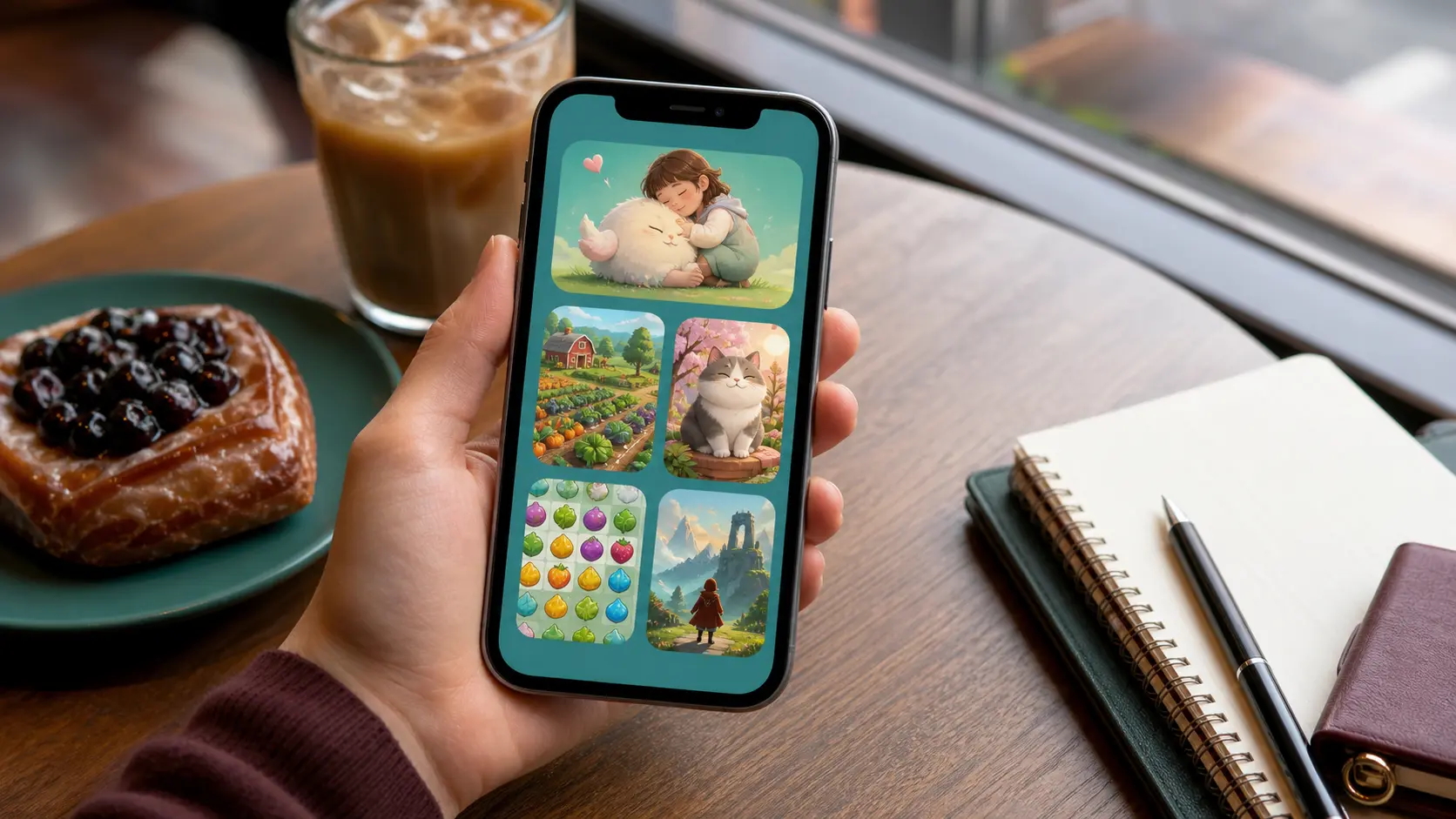
AIdorable is a nurturing companion game where you adopt an AI baby, check in, care for it, and watch the relationship grow. Instead of chasing a leaderboard, you create a small ritual around attention and affection.
That makes it different from a traditional cozy game. The central activity is not winning; it is showing up. For players drawn to self-care game apps, virtual pets, or experiences where you take care of something, that tiny act of care can offer warmth without demanding a long session.

How to Pick the Right Game in 30 Seconds
When your mood is low, a giant recommendation list can become another decision. Use this quick filter instead.
Name the state, not the whole story
Try one simple sentence: “I feel restless,” “I feel lonely,” “I feel mentally crowded,” or “I feel flat.” You do not need to analyze your entire emotional life before you play.
Choose the opposite—or choose support
If you feel overstimulated, pick a quiet puzzle. If you feel sluggish, try music and movement. If you feel lonely, invite a trusted friend or choose a game built around kind connection. If you feel fragile, choose familiar comfort rather than challenge.
Make the first session small
Set a soft 10- or 20-minute check-in. This is not a strict timer; it is a chance to notice whether the activity is helping. Ask:
- Do I feel more present?
- Is my body less tense?
- Am I enjoying this, or only avoiding stopping?
- Would food, water, sleep, fresh air, or a conversation help more now?
A healthy self-care choice can include closing the game.
Mood-Boosting Play Without the Emotional Hangover
The difference between restorative gaming and avoidance is not always the number of minutes. Intention matters too. You may spend a wonderful evening exploring with a friend, while ten irritated minutes in a punishing match can leave you feeling worse.
A few boundaries keep play friendly:
- Turn off competitive chat if it adds pressure or anxiety.
- Lower difficulty settings without shame.
- Avoid games with aggressive monetization when spending feels impulsive.
- Protect sleep by choosing games with clear stopping points at night.
- Pair play with basic care: water, a snack, medication, stretching, or daylight.
- Notice repeated emotional patterns instead of judging one session.
If you specifically need help settling a racing mind, our guide to games that calm anxiety goes deeper into low-pressure mechanics. For a broader look at therapeutic play and its limits, see games for mental health. And if what you want is pure softness, start with these cute relaxing games.
When a Game Is Not Enough
A video game can support an emotional shift, but it is not a replacement for mental health treatment. Persistent sadness, anxiety, loss of interest, major changes in sleep or appetite, or thoughts of self-harm deserve real human care.
Reach out to someone you trust, a qualified mental health professional, or an appropriate crisis service in your country. You are not failing at self-care because a cozy game cannot carry something heavy by itself.
Conclusion: Pick the Smallest Game That Helps
The best mood boosting games do not force happiness. They create conditions where a better feeling has room to appear: focus, play, movement, connection, creativity, comfort, and a manageable win.
Choose for the mood you have, not the person you think you should be. Play one race, place one tile, unpack one room, dance to one song, or care for one tiny companion. Then pause and notice what changed.
A small lift still counts.