When anxiety turns your mind into a browser with thirty-seven tabs open and one of them playing music, “just relax” is not useful advice. A small, predictable game sometimes is.
The right game gives your attention somewhere safe to land. It does not demand peak performance, punish you for looking away, or blast you with five currencies and a limited-time event. It offers one understandable action, then another.
This guide covers games to calm anxiety across phones, consoles, and computers. These are not cures or substitutes for care. Think of them as small regulation tools: something to help you cross the space between I am overwhelmed and I can choose my next step.
Quick Guide: Pick a Game for the Anxiety You Have Right Now
| If you feel… | Try this game style | Look for | Skip for now |
|---|---|---|---|
| Mentally stuck in a worry loop | Untimed puzzle | Clear rules, hints, short rounds | Countdown clocks |
| Physically restless | Repetitive sensory game | Swiping, sorting, gentle rhythm | Precision platforming |
| Emotionally raw | Nurturing game | Feeding, decorating, checking in | Sad story twists |
| Sensory overloaded | Minimal cozy game | Soft audio, simple screen, pause-anytime play | Flashing effects and busy UI |
| Drained but lonely | Virtual pet or companion game | Warm continuity and tiny care tasks | Competitive multiplayer |
| Unable to decide anything | Familiar comfort game | A known routine and easy stopping point | A giant new open world |
The important question is not “What is the most relaxing game?” It is “What kind of input can my nervous system tolerate today?”
12 Relaxing Games for Anxiety and Stress That Help You Unwind
1. Monument Valley: a quiet visual puzzle
Monument Valley turns each level into a small piece of impossible architecture. You rotate paths, shift platforms, and guide a character through an elegant optical illusion.
It works well when anxious thoughts need a gentle cognitive task. There is enough structure to occupy attention without the frantic energy of a timer or leaderboard. The levels are also naturally bounded, so you can finish one chapter and put the phone down.
2. I Love Hue: color sorting without pressure
In I Love Hue, you rearrange colored tiles until they form a smooth gradient. The action is repetitive, visual, and easy to understand even when concentration is thin.
This is a strong choice for sensory soothing because success arrives gradually. You are not battling an opponent; you are restoring order. If color is calming to you, the completed gradient can feel like a tiny, Zen exhale.
3. Prune: slow growth and simple decisions
Prune asks you to trim a growing tree so its branches can reach the light. Its restrained art and spacious design make it feel less like a busy mobile game and more like an interactive poem.
The meditative gameplay is useful when you want a calm, deliberate action. Each cut matters, but failure does not feel catastrophic. That balance—attention without urgency—is what an effective relief game gets right.
4. Unpacking: familiar objects and visible progress
Unpacking is a story told through boxes. You remove household objects and find a place for each one. There are no dialogue trees, enemies, or ticking clocks.
Sorting can be comforting when life feels shapeless because every object gives you one solvable question: Where does this go? The game also creates visible progress, which may feel grounding when your real to-do list is too large to approach.
It may not suit everyone. If clutter, moving, or domestic expectations are current stressors, choose something less close to home.

5. Dorfromantik: build a landscape one tile at a time
Dorfromantik lets you place hexagonal tiles to create forests, villages, rivers, and fields. Its standard mode includes goals, but the atmosphere remains unhurried, and creative play removes much of the pressure.
This is a good option when you want calm with a little strategy. One tile gives you a narrow decision instead of an entire world to manage. The growing landscape provides a satisfying sense of coherence.
6. Townscaper: a toy rather than a task
Townscaper has almost no rules. Tap to create colorful buildings; tap again to change their shapes. The system turns simple input into charming streets, arches, and towers.
Because there is no real way to lose, it is useful on days when even a cozy quest feels like work. You can build for two minutes or twenty. It is a relaxing game that leaves room for your mind to become quieter rather than filling every second.
7. Stardew Valley: a familiar routine, with one caution
Stardew Valley offers farming, fishing, decorating, relationships, and a repeating daily rhythm. For many players, returning to a familiar farm feels comforting because the world is understandable and the tasks are concrete.
But its in-game clock can also trigger optimization mode. If you start calculating perfect crop yields while your shoulders crawl toward your ears, it is not the calming choice tonight. Play loosely, choose one pleasant task, and let the imaginary parsnips survive without a five-year plan.
8. Animal Crossing: gentle collecting and social warmth
Nintendo's Animal Crossing builds calm around small rituals: checking the shop, decorating a room, fishing, or talking to familiar neighbors. Its real-time pace encourages regular visits rather than a dramatic rush to finish.
It can help when anxiety comes with loneliness or emotional flatness. The game offers light social texture without demanding a real-time conversation. Still, avoid turning daily tasks into obligations; a comfort game should not become another person you think you are disappointing.
9. A Short Hike: movement without danger
A Short Hike gives you a small island to explore at your own pace. You can climb, glide, chat, fish, or simply wander toward the summit.
Its scale is part of the comfort. Open-world games can become overwhelming because every horizon creates more choices. This world is compact enough to feel inviting, and movement feels playful rather than punishing.
10. Tetris Effect: absorbing rhythm for restless attention
Tetris Effect combines a familiar block puzzle with music and responsive visual effects. For some people, the repetitive decisions create deep focus and interrupt rumination.
For others, speed and sensory intensity do the opposite. Choose a relaxed mode, lower the volume, and notice your body after one round. A game earns the word calming by its effect on you—not by its store category.
11. AIdorable: turn anxious energy into a tiny care ritual
Sometimes you do not need a sprawling adventure. You need one soft task that says, I can care for something right now.
AIdorable is a nurturing game built around adopting and caring for a tiny AI baby. Short check-ins, play, and relationship growth make it closer to a daily care ritual than a conventional challenge loop. That can suit anxiety that feels lonely, restless, or directionless.
If this style appeals to you, see how nurturing play fits into the wider world of games for mental health and why a self-care app for anxiety should feel supportive rather than demanding.
12. Familiar games you already know by heart
Do not underestimate the game you have played for years. Familiar mechanics reduce decision load. You already know the controls, the music, the safe places, and exactly when you can stop.
Your comfort game might be solitaire, Mahjong, a match-three puzzle, a life simulator, or an old handheld favorite. Familiarity is not boring when your brain is scanning for threats. It is evidence that the next five minutes are predictable.
The most calming game is not the one with the coziest art. It is the one that leaves you more present than it found you.
Why Playing a Game Can Reduce Anxiety and Stress
Anxiety often pulls attention toward uncertain future outcomes. A gentle game pulls it toward a specific present action: place this tile, sort this color, water this plant.
These games that help interrupt worry may offer a useful form of stress relief because they can:
- A narrow focus. One manageable task competes with repetitive worry.
- Predictable feedback. The game responds consistently when the rest of life feels uncertain.
- Low-stakes agency. You can make a choice and see a result without a serious consequence.
- Rhythm and repetition. Familiar motion can occupy restless hands and attention.
- A clear boundary. A level, day, or puzzle provides a natural stopping point.
That does not mean gaming always helps. Fast competition, hostile voice chat, loot pressure, flashing effects, or an impossible quest can amplify stress. Even a gentle game can become avoidance if it repeatedly replaces sleep, meals, work, treatment, or needed conversations. No game can promise to alleviate anxiety, especially severe anxiety, but it may be one self-care tool that helps you cope with anxiety in the moment.
How to Choose Calming Games for Stress and Anxiety
Turn off the artificial urgency
Disable nonessential notifications, haptics, and promotional alerts. Choose offline or single-player modes when social comparison makes you tense. If a game uses streaks, remember: a streak is a design feature, not a moral obligation.
Prefer easy exits
The best games to calm anxiety let you pause immediately and save often. A ten-minute tool is more useful when it does not trap you in a forty-minute match.
For phone-specific ideas, browse these calming games for iPhone, relaxing games for Android, or our broader list of cute relaxing games. If you are looking for games on Nintendo Switch and PC, Animal Crossing, Stardew Valley, Dorfromantik, and Unpacking are strong starting points; take your time and choose the gentlest mode.
Other games like Animal Crossing include Disney Dreamlight Valley and Palia. Both add quests and more systems, so they suit you better when complexity feels engaging rather than exhausting. There are many levels of difficulty hidden inside the word “cozy.” Start with a simple puzzle game if you need games to help you relax, then try a larger world when you have more attention available. The goal is not to find a perfect anxiety coping game; it is to keep your mind gently occupied and help you cope with stress without adding another demand.
Make a tiny “calm folder” before you need it
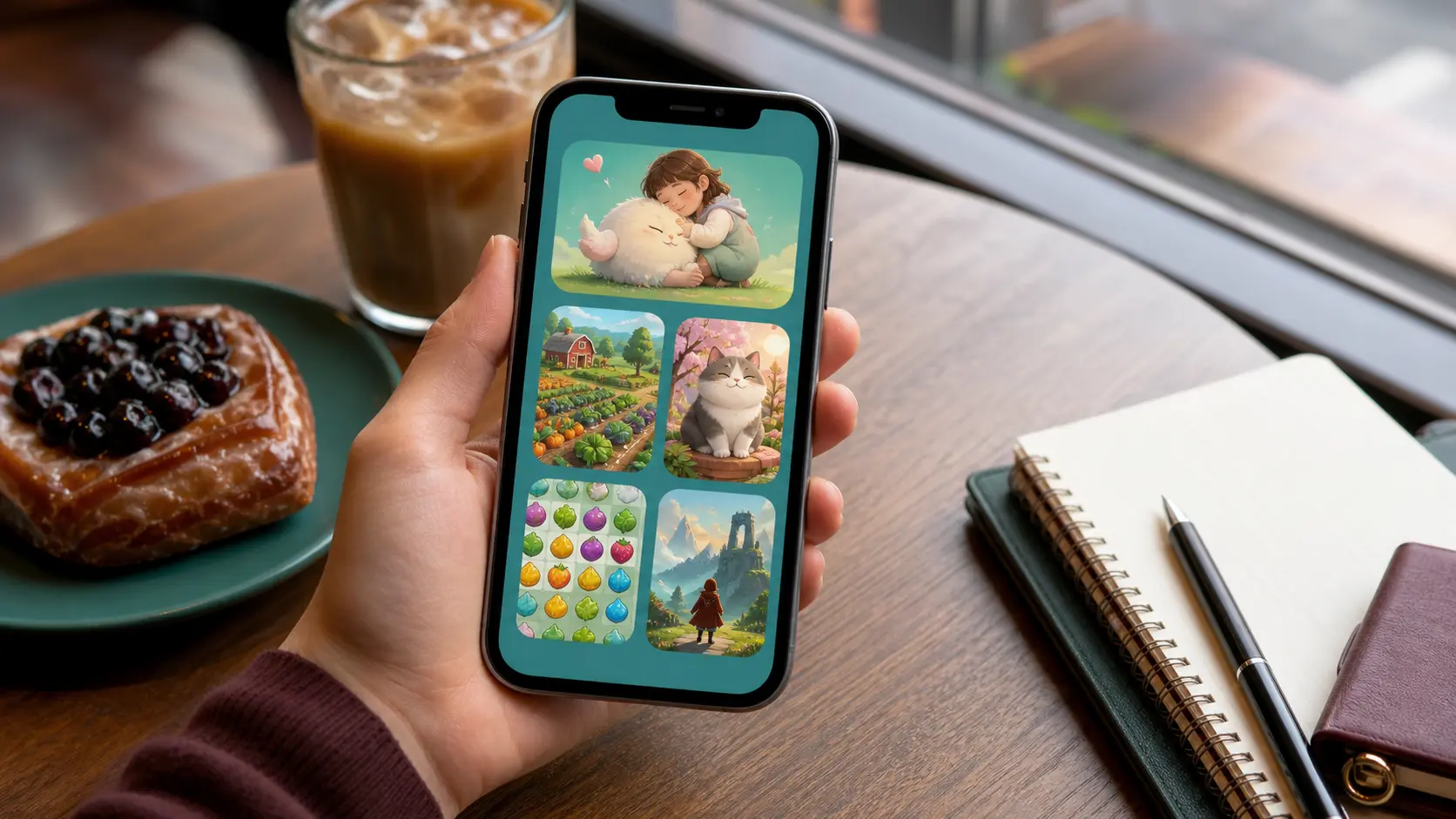
Decision-making gets harder when you are activated. Put two or three reliable games in one phone folder now: perhaps one puzzle, one sensory game, and one nurturing option.
Check the result, not just the escape
After ten minutes, pause and ask:
- Is my breathing slower or still shallow?
- Are my jaw and shoulders softer?
- Do I feel more able to choose my next action?
- Am I pleasantly absorbed, or numb and unable to stop?
If you feel worse, the game is not failing and neither are you. It is simply the wrong input for this moment. Try a dimmer screen, quieter audio, a glass of water, a brief walk, or contact with someone safe.
Pair the screen with a grounding cue
A calming game works better when it reconnects you to the room rather than making the room disappear. Before opening it, place both feet on the floor and notice three things you can see, three sounds you can hear, and three parts of your body you can move. This resembles the popular 3-3-3 grounding rule for anxiety.
Then play one short round. When it ends, look away from the screen and repeat the check. You are not trying to force anxiety to vanish. You are giving attention a path back to the present.
If breath-focused exercises make you more anxious, do not force them. Use external anchors instead: the weight of the phone, the edge of the chair, a cool drink, or the colors in the game. Grounding is personal, and the least dramatic tool is often the easiest one to use.
A 15-Minute Calming Game Ritual
Use this simple structure when you want relief without losing the evening:
- Name the need. “My thoughts are looping,” or “I am overstimulated.”
- Choose one matching game. Puzzle for rumination, low-input play for overload, nurturing play for lonely restlessness.
- Set a gentle 15-minute timer. The timer is an exit door, not a productivity challenge.
- Play with the sound and brightness adjusted. Make the environment actually calm.
- Close with one physical action. Stretch, drink water, wash your face, or step outside.
- Reassess. Continue your day, choose another coping tool, or ask for support.
If anxiety is frequent, severe, or interfering with daily life, a game is not the whole plan. A licensed mental-health professional can help you build one. If you may harm yourself or are in immediate danger, contact local emergency services or a crisis line in your country now.
Conclusion: Choose the Game That Makes the World Feel Manageable
The best games to calm anxiety are not necessarily marketed as wellness tools. Some are called chill games, cozy games, games for stress, or anxiety relief games. What matters is the emotional shape: predictable, forgiving, absorbing, and easy to leave.
Try an untimed puzzle when your thoughts loop. Build a tiny town when decisions feel heavy. Return to a familiar farm when novelty is too much. Care for a small companion when anxious energy needs somewhere gentle to go.
Keep the session intentional, notice how you feel afterward, and let the game do one modest job. It does not have to fix your life. It only has to help the next few minutes feel manageable.