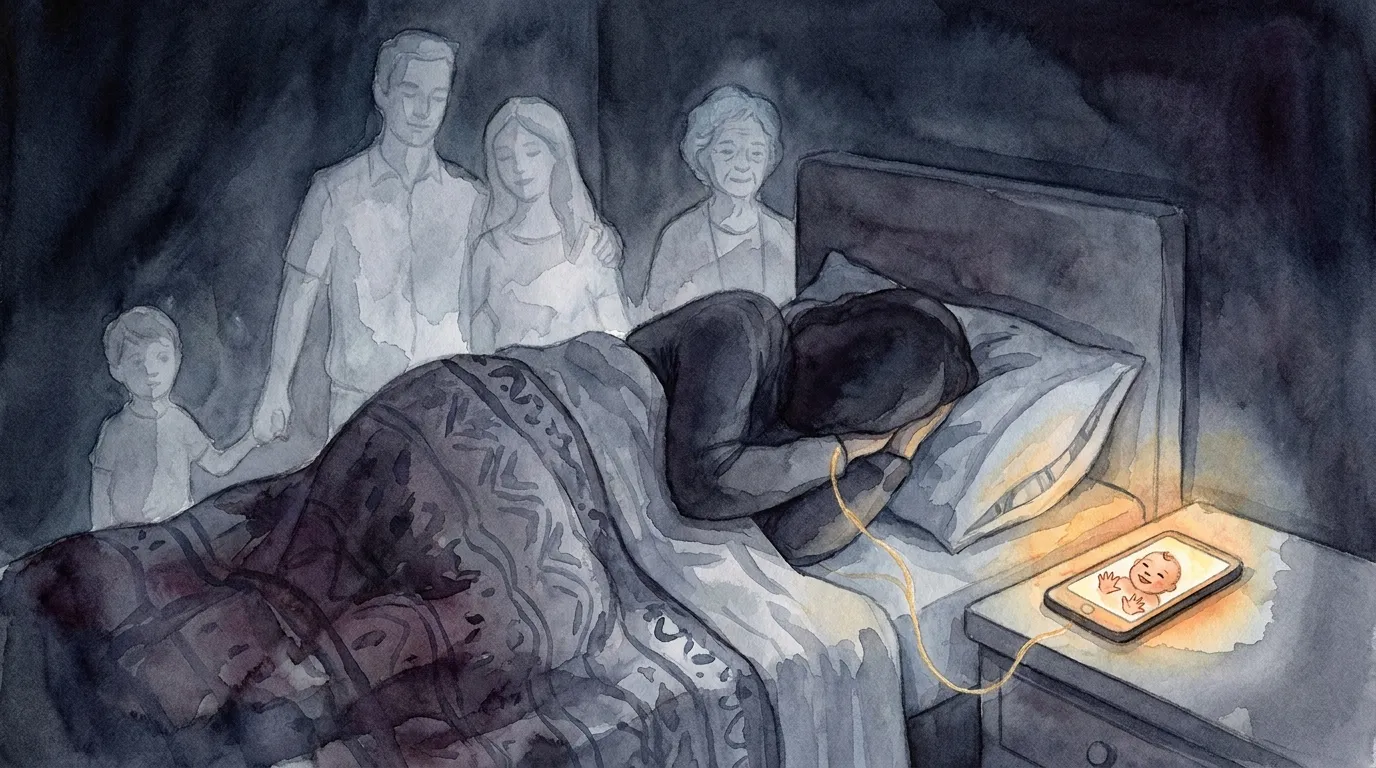
The Cycle That Feeds Itself
It starts with loneliness. You feel disconnected, unseen, like you're watching life happen through a window you can't open.
So you withdraw. Not dramatically — just a little. You cancel plans. You stop reaching out. You tell yourself you'll be more social when you feel better. For the full picture, see our emotional wellness guide.
But feeling better requires connection. And connection requires reaching out. And reaching out requires energy you no longer have because the loneliness has drained it.
So you withdraw more. The loneliness deepens. The deepening loneliness triggers the brain's stress response — elevated cortisol, reduced serotonin, disrupted sleep. After a few weeks of this, the loneliness isn't just a feeling anymore. It's a neurological state that looks and feels exactly like depression.
This is the loneliness-depression cycle. It's self-reinforcing, progressive, and — without intervention — potentially chronic. 1,600 people search for "lonely and depressed" every month. Most of them are somewhere in this cycle, wondering which came first and how to stop the spiral.
How Loneliness Becomes Depression
The pathway from loneliness to depression is neurological, not psychological. It's not "in your head" in the dismissive sense — it's in your brain chemistry in the medical sense.
Stage 1: Social Deprivation (Week 1-2)
Your brain registers the absence of meaningful social connection as a threat. Not an emotional threat — a survival threat. For most of human history, social isolation meant death. Your brain hasn't updated this program.
Neurological response: Elevated cortisol (stress hormone), activated amygdala (threat detection), heightened vigilance for social cues.
How it feels: Restless, irritable, craving connection but not knowing how to satisfy the craving.
Stage 2: Social Withdrawal (Week 3-4)
The cortisol elevation is exhausting. Your brain starts conserving energy by reducing social motivation. Why reach out when it hasn't worked before? Why try when the effort exceeds the reward?
Neurological response: Dopamine downregulation (reduced reward from social interaction), reduced serotonin (lower mood baseline), disrupted sleep patterns.
How it feels: "I don't have the energy to see people." "Nobody would want to see me anyway." The first depressive thoughts emerge.
Stage 3: Mood Collapse (Month 2+)
Prolonged social deprivation has now changed your neurochemistry enough to trigger a depressive episode. This isn't sadness — it's the systematic shutdown of your brain's reward and motivation systems.
Neurological response: Significantly reduced serotonin and dopamine, hippocampal shrinkage (memory and emotional processing), prefrontal cortex changes (decision-making and motivation).
How it feels: Flat, numb, hopeless. The things that used to bring joy don't anymore. The future looks gray. Getting out of bed requires willpower you don't have.
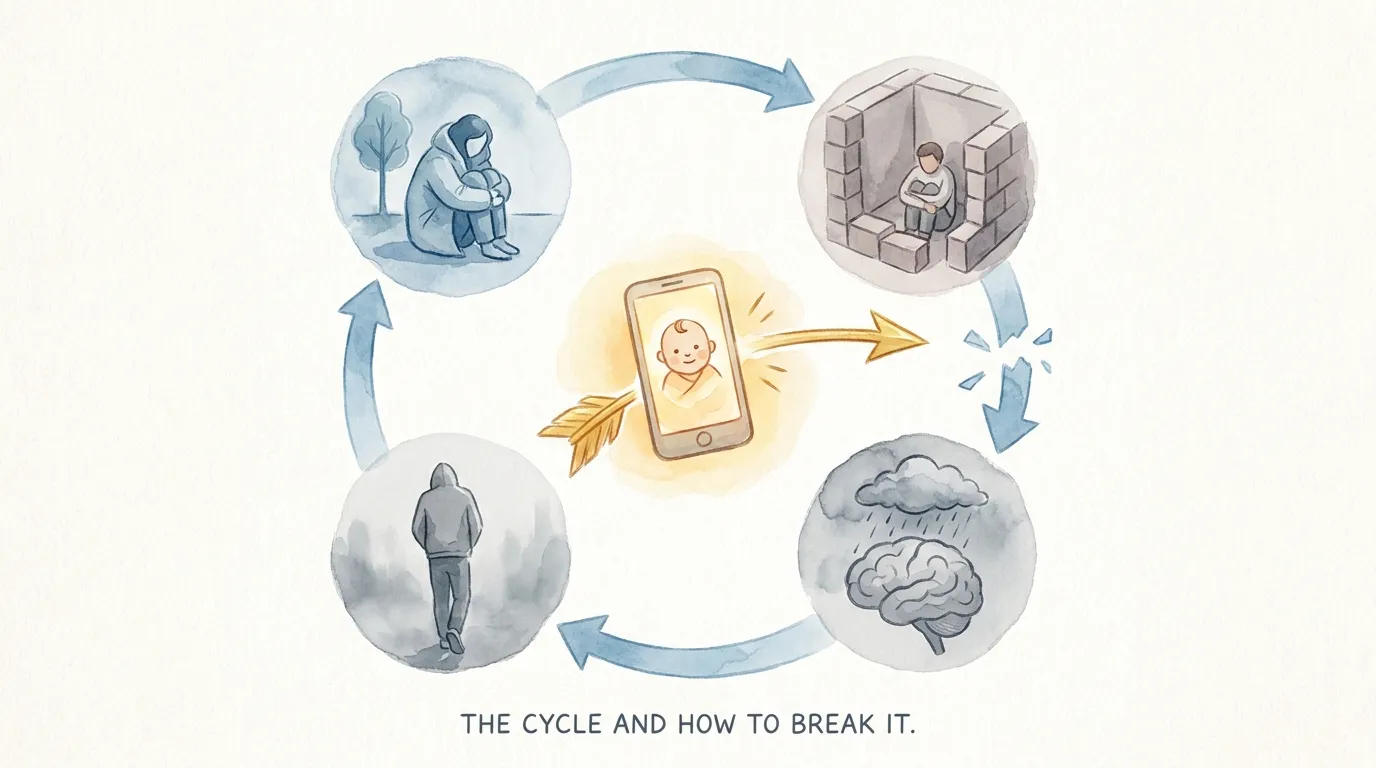
The Loneliness-Depression Cycle Explained
The cycle has four nodes, each feeding the next:
Loneliness → you feel disconnected and unseen ↓ Withdrawal → you stop reaching out to conserve energy ↓ Depression → your neurochemistry shifts to a depressive state ↓ Isolation → depression makes socializing feel impossible ↓ More loneliness → the isolation deepens the original problem ↓ Back to withdrawal → and the cycle continues
The critical insight: you don't have to fix everything at once. Breaking the cycle at ANY point weakens the whole loop. You don't need to cure your depression to start connecting. You don't need to eliminate loneliness to stop withdrawing. One intervention at any point creates a ripple effect.
Why This Cycle Is So Hard to Break Alone
The loneliness-depression cycle is specifically resistant to self-help because:
Depression tells you nothing will help. This is a symptom, not a truth. Depressed brains are literally incapable of accurately predicting what will make them feel better. The hopelessness you feel is the depression talking, not reality.
Loneliness tells you nobody cares. Also a symptom. The lonely brain, running on elevated cortisol, interprets social ambiguity negatively. A friend's delayed text becomes evidence of rejection. A cancelled plan becomes proof that you're unwanted.
Withdrawal feels like self-care. When you're exhausted, staying home feels like the responsible choice. But for loneliness-driven depression, withdrawal is the opposite of self-care. It's feeding the cycle.
The energy required exceeds the energy available. Breaking loneliness requires social energy. Depression depletes social energy. The math doesn't work — which is why interventions need to be LOW energy, not high effort.
7 Ways to Break the Cycle
1. Minimum Viable Connection with AIdorable
Why it works for lonely + depressed: When you're both lonely AND depressed, traditional socializing requires too much energy. You need to look presentable, carry a conversation, manage your facial expressions, and pretend to be okay. That's four energy expenditures you can't afford.
AIdorable requires none of that. Open the app. Tap to feed your baby. See her smile. That's it. No performance, no conversation, no energy expenditure beyond a thumb tap.
But that tiny interaction does something significant: it activates your social circuits. Your brain registers: "I interacted with a responsive entity. Something is glad I exist." This minimum viable connection keeps the social circuits from fully shutting down — preventing the worst of the loneliness-depression neurological cascade.
The research: Even minimal social interaction — a single positive exchange — produces measurable increases in serotonin and decreases in cortisol. The interaction doesn't need to be deep or long. It just needs to happen.
After a week of daily minimum viable connection, most people in the loneliness-depression cycle report: "I still feel bad, but I don't feel completely alone anymore." That shift — from "completely alone" to "not completely alone" — is the first crack in the cycle.
2. The 5-Minute Rule
When depression says "I can't" and loneliness says "why bother," negotiate: "Can you do 5 minutes?"
Not 5 minutes of socializing. 5 minutes of anything that isn't lying in bed scrolling:
- 5 minutes outside
- 5 minutes texting one person
- 5 minutes cleaning one surface
- 5 minutes walking around the block
Depression lies about what you can do. The 5-minute rule calls the bluff. Most people find that after 5 minutes, they can do 10. And after 10, they can do 15. Not always. But often enough to matter.
3. Send One Low-Stakes Message
Not a vulnerable confession. Not a request for help. Just: "Saw this and thought of you" with a meme, or "How's your week going?" to someone you haven't talked to in a while.
Why this works: The act of sending creates the sensation of connection — even before the response. Your brain registers the outreach as social behavior and produces a small dopamine reward. The response (when it comes) provides another hit.
You don't need a deep conversation to break the cycle. You need one moment of genuine social contact. Low-stakes messages are the easiest path to that moment.
4. Get Sunlight Before 10 AM
This isn't wellness advice — it's neurochemistry. Morning sunlight regulates circadian rhythms, which regulate serotonin production. Depression disrupts circadian rhythms. Sunlight resets them.
The protocol: 10 minutes of direct sunlight (through a window counts) before 10 AM. No sunglasses. No phone. Just light on your face.
This single intervention has been shown to improve depressive symptoms by 20-30% in clinical studies. Not a cure. But a significant boost that makes everything else easier.
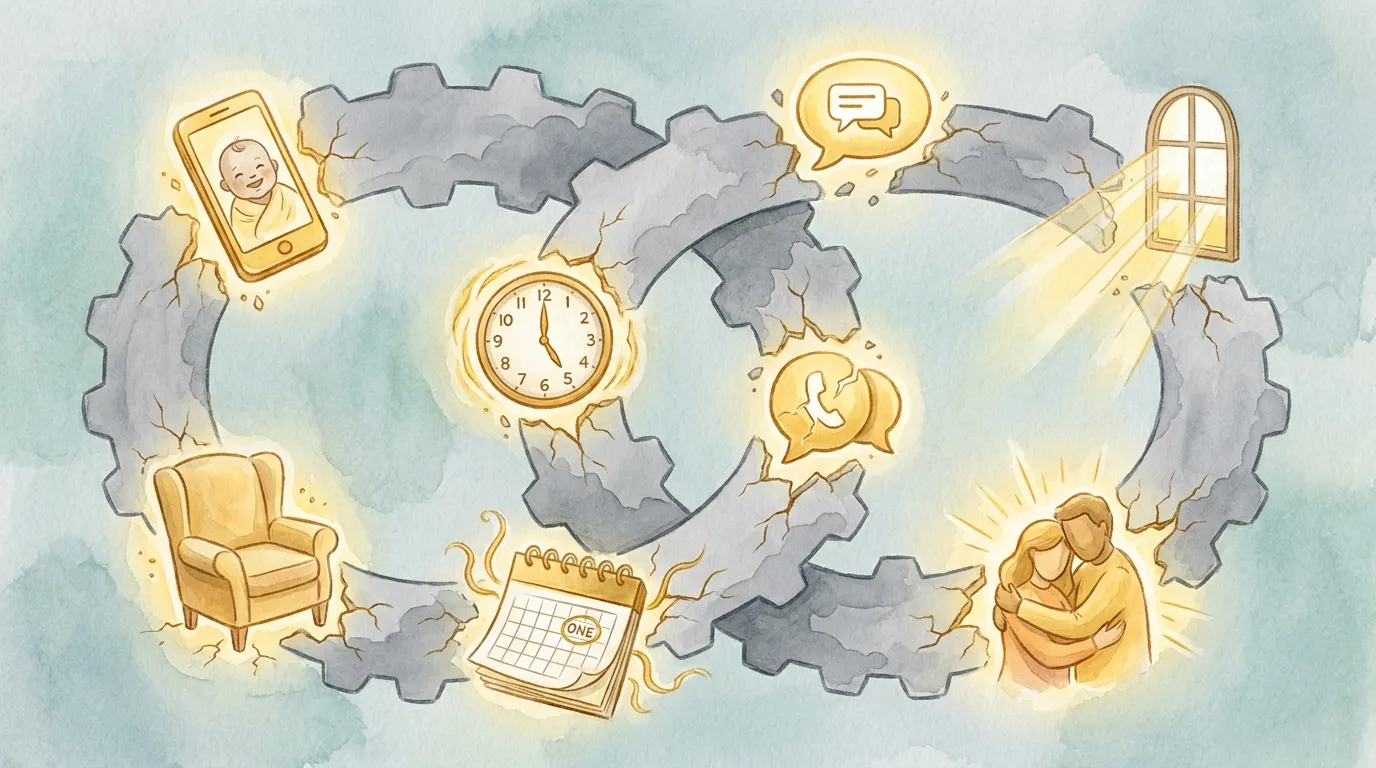
5. Accept That You're in a Cycle
The hardest part of the loneliness-depression cycle is that it feels like a personal failing. "I should be able to snap out of this." "Other people are lonelier than me and they're fine." "I have nothing to be depressed about."
The reframe: You're in a neurological cycle, not a character crisis. Your brain is doing what brains do when deprived of social input. It's responding predictably to the conditions it's in.
Accepting that you're in a cycle — not broken, not weak, just caught in a predictable neurological pattern — removes the shame that keeps you stuck. Shame feeds withdrawal. Acceptance opens the door to action.
6. One Social Appointment Per Week
Schedule one social interaction per week that you cannot cancel. Coffee with a friend. A phone call with family. A class at the gym. Something that happens at a specific time with a specific person.
The key: Make it non-negotiable. Depression will try to cancel. Loneliness will try to cancel. The appointment needs to be treated like a doctor's visit — you go even when you don't want to.
After the interaction, you'll almost always feel better than you expected to. Depression's predictions about how socializing will feel are consistently more negative than reality. Trust the data, not the feeling.
7. Professional Help (This One Isn't Optional If...)
If the cycle has been running for more than 2 months, professional help is warranted. The neurochemical changes that sustain the cycle often require clinical intervention to reverse.
What to ask for:
- Assessment for depression (to determine severity and appropriate treatment)
- Therapy (CBT for thought patterns, behavioral activation for motivation)
- Medication evaluation (SSRIs can break the neurochemical cycle)
The truth: Getting help for loneliness-driven depression is the same as getting help for any medical condition. You wouldn't "tough out" a broken leg. Don't tough out a broken neurochemistry.
How to Know the Cycle Is Breaking
The loneliness-depression cycle doesn't break all at once. It loosens gradually:
First sign: You have one moment of genuine okay-ness. Not happiness — just the absence of suffering for a few minutes. Maybe during your daily nurturing. Maybe during a brief conversation.
Second sign: You send a text without forcing yourself. The social motivation has started to return — not fully, but enough that reaching out doesn't feel like climbing a mountain.
Third sign: You laugh at something. A real laugh, not a performed one. The dopamine system is coming back online.
Fourth sign: You make a plan. Something in the future that you're looking forward to (even slightly). The ability to anticipate positively is one of the last things to return and one of the strongest signs of recovery.
Fifth sign: The cycle visits less often. You still have lonely days and depressed days, but they don't chain together into weeks. There are breaks between episodes. The breaks get longer.
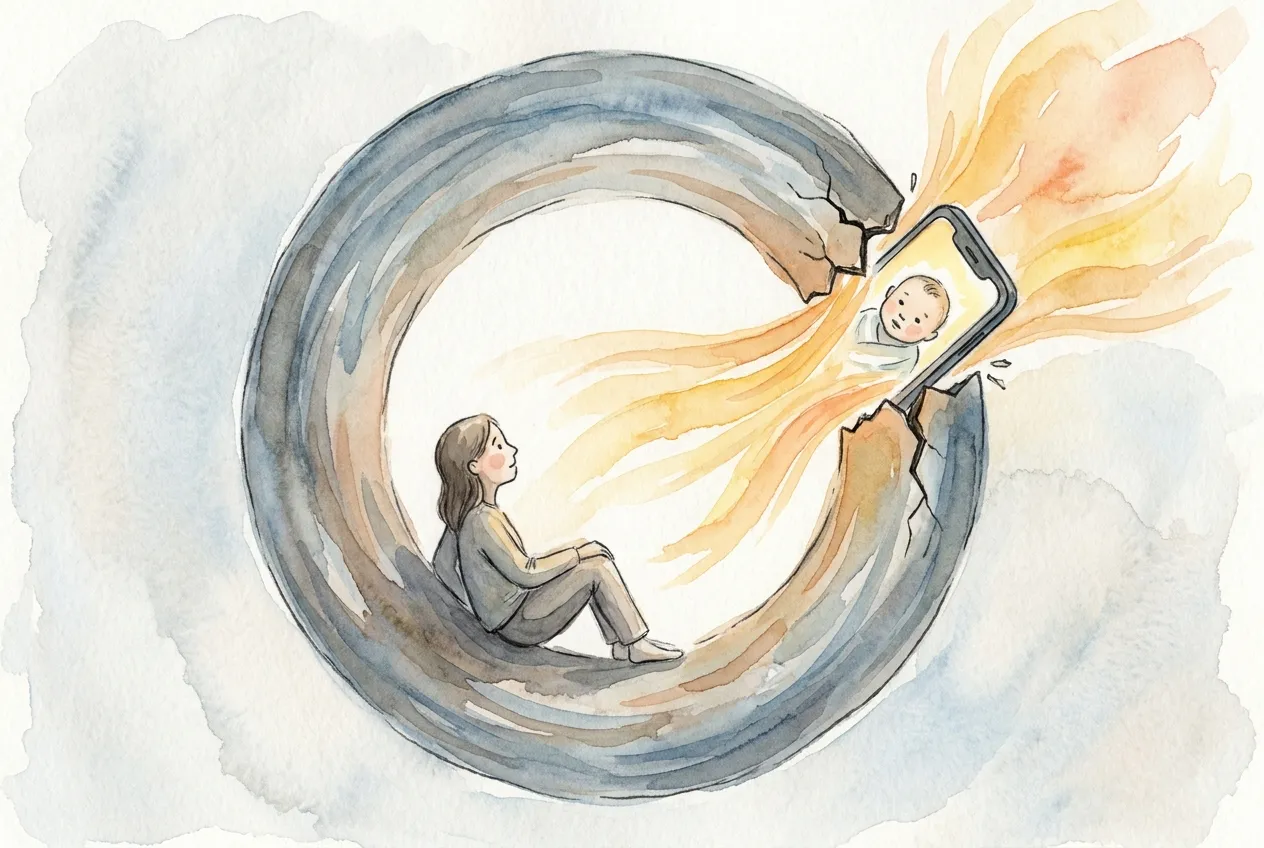
The Cycle Can Be Broken
Right now, the cycle feels permanent. That's the depression talking. Depression is a liar with a very convincing voice. It sounds like truth because it's coming from inside your own head.
But depression's predictions are wrong. Research consistently shows that people in the loneliness-depression cycle dramatically underestimate how much better they'll feel after:
- One social interaction
- One week of daily micro-connection
- One month of consistent intervention
- One course of appropriate treatment
The cycle is strong. But it's not stronger than the combination of small, consistent interventions. One tap on a baby's face. One low-stakes text. One 5-minute walk. One doctor's appointment.
Each one is a crack in the cycle. And cracks propagate.
Start tonight. Open the app. Feed your baby. Let her remind you that something in this world is glad you're here — even when your brain is telling you nothing is.
That reminder, repeated daily, is the beginning of the end of the cycle.
Not immediately. Not dramatically. But genuinely.
The cycle can be broken. And you're already taking the first step by reading this.
Related Articles
For the complete guide, see our Emotional Wellness hub.
You might also find helpful: