
Free quiz · 3 minutes · no sign-upWould I be a good mom?
Twelve small moments, and what they say about how you care. No score and no verdict.

- With her
- With yourself
- With your people
She laughs at something you did by accident. What do you do?
For everyone who asks
The worry behind the question
Most people who ask whether they would be a good mom are carrying one of these. Here is what the research says about each.
“I would repeat how I was raised.”
Studies that follow families do find a link between how people were raised and how they parent. It is a modest one, and smaller in newer studies than in older ones: a tendency, not a sentence. In one early study, parents who had made sense of a difficult childhood parented much like those who described an easy one.
Verhage and colleagues (2016), Psychological Bulletin: three decades of research on the intergenerational transmission of attachment · Pearson and colleagues (1994), Development and Psychopathology: earned and continuous security in adult attachment
“I would lose my temper.”
Every caregiver gets overwhelmed. The guidance given to new parents is plain: lay the baby down somewhere safe, step away for a few minutes, come back. Knowing that is allowed is part of good care, not a failure of it.
“I do not feel maternal.”
We could not find research showing that feeling maternal now, or loving babies in general, tells you what kind of mother you would be. Researchers increasingly describe caring as something built by doing it: in a study of fathers, the more time they spent caring for their baby, the more the brain’s caregiving network showed it.
Abraham and colleagues (2014), PNAS: Father’s brain is sensitive to childcare experiences
“I would not know what to do.”
Nobody does at first. Trials of short coaching programs for parents show that reading and answering a baby is a skill that improves with practice and good guidance.
“I would get it wrong.”
You would, often. Researchers who filmed mothers with their babies found the pairs were in step only a small part of the time. What they describe as ordinary, healthy care is noticing and gently putting it right.
Tronick and Cohn (1989), Child Development: coordination and miscoordination in infant-mother interaction · Guo and colleagues (2015), Infant and Child Development: mismatch and repair between mothers and babies
What the research says
What makes a good mom? Six things people learn
No quiz can predict what kind of mother anyone would be, and nobody has tested this one as a measure. What research does describe is a set of things caregivers do, every one of them learned. The quiz is built on these six.

Noticing
Noticing a baby’s signals and answering them is one of the best-studied parts of caring for one. So is wondering what the baby might be feeling. In a review of the research, both went with babies who felt secure with their parents.
Harvard Center on the Developing Child: serve and return · Zeegers and colleagues (2017), Psychological Bulletin: parental mentalization and sensitivity as predictors of infant-parent attachment

Joining in
Harvard’s Center on the Developing Child calls the back-and-forth between a baby and a caring adult “serve and return”. In its own words: “it takes two to play!”
Harvard Center on the Developing Child: 5 steps for brain-building serve and return

Staying steady
Every caregiver gets overwhelmed sometimes. The guidance given to new parents is plain: lay a crying baby down somewhere safe, step away for a few minutes to calm down, then go back.

Putting it right
Researchers who filmed mothers playing with their babies found the pairs were in step only a small part of the time. What they describe as ordinary, healthy care is the moving back from out of step to in step.
Tronick and Cohn (1989), Child Development: coordination and miscoordination in infant-mother interaction · Guo and colleagues (2015), Infant and Child Development: mismatch and repair between mothers and babies
Letting people in
The anthropologist Sarah Blaffer Hrdy argues that human mothers have always raised babies with help from others. Being willing to ask for help and take it is a strength.
Sarah Blaffer Hrdy, Mothers and Others: The Evolutionary Origins of Mutual Understanding (Harvard University Press, 2009)

Learning as you go
Trials of short coaching programs for parents show that reading and answering a baby is a skill that improves with practice. In one study of fathers, time spent caring for a baby went with stronger links in the brain’s caregiving network.
Cochrane review (2019): video feedback for parental sensitivity and attachment security in children under five · Abraham and colleagues (2014), PNAS: Father’s brain is sensitive to childcare experiences
Being ready is a different question
Ready is about timing: money, work, a home, the people around you, and whether you want a child at all. This quiz is not about any of that, and it says nothing about whether or when to have one. It is only about how you care for someone in front of you, which you already do every day.
Free printable
Twelve conversations to have before becoming a parent
A free printable. Written for one person with a notebook, with a second column if you have a partner. It does not take a side on whether to have children.
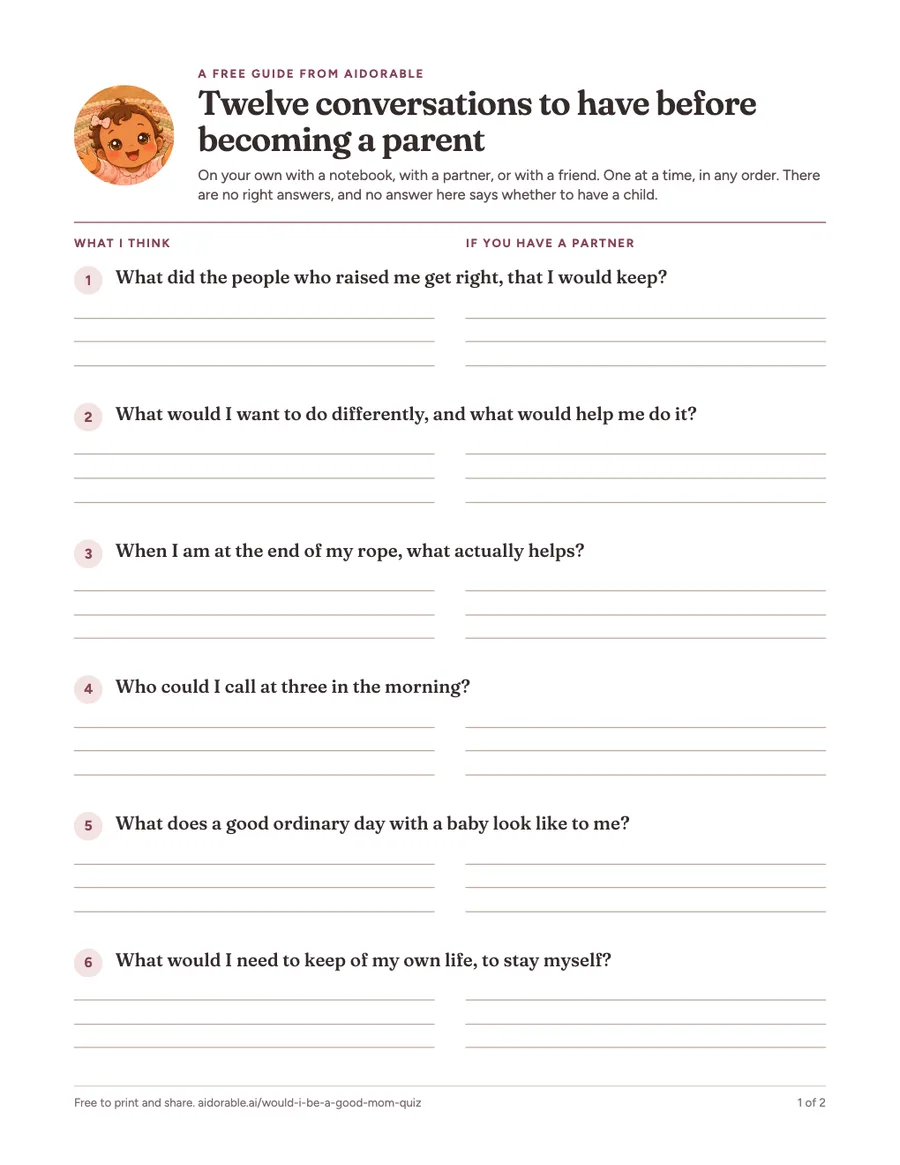
- What did the people who raised me get right, that I would keep?
- What would I want to do differently, and what would help me do it?
- When I am at the end of my rope, what actually helps?
- Who could I call at three in the morning?
- What does a good ordinary day with a baby look like to me?
- What would I need to keep of my own life, to stay myself?
- Who would do the nights, the laundry and the appointments?
- What would work and childcare look like in the first year?
- What would it cost, and what would I change to meet it?
- What do I believe about comfort, routine and saying no?
- What if it is harder than I expect: to get there, or once it is here?
- Why now, why later, or why not? Whose voice is that?
Free to print and hand out, at home or in a class. The topics follow the lists that researchers and family educators use, rewritten for one person first.
In the open
How this quiz was made
Written by the AIdorable team in November 2026 from the sources listed below. No clinician has reviewed it, and nobody has tested it as a measure of anything.
There are twelve moments with four answers each. Every answer leans on one of the six strengths, and each strength is offered eight times, so no result is easier to land on than another. The strength you choose most is your first, the next is your second, and the one you choose least is the one to grow. A tie goes to the strength you chose later.
So the result shows what you reach for first among good options. It does not measure how much of anything you have.
Your answers and your result are worked out in your browser and are not sent to us or to anyone else.
This is a short reflection, not a test or an assessment. It cannot predict what kind of parent anyone would be, and it is not medical or psychological advice.
See all twelve moments, and what each answer leans on
| The moment | The answer | It leans on |
|---|---|---|
| 1. She laughs at something you did by accident. What do you do? | Do it again. And again. Forty times. | Joining in |
| Watch her face to see which bit was funny. | Noticing | |
| Film it for the people I love. | Letting people in | |
| Make a note: socks on hands, comedy gold. | Learning as you go | |
| 2. She pushes the bottle away and scowls at you. What goes through your head? | What is she trying to tell me? | Noticing |
| Fine. Breathe. We will try again in five. | Staying steady | |
| I will look up what this can mean. | Learning as you go | |
| Did I rush her? Slow down and offer again. | Putting it right | |
| 3. She is crying and nothing obvious is wrong. What is your first move? | Listen to the cry itself. Tired? Sore? Lonely? | Noticing |
| Slow my own breathing first, then hold her. | Staying steady | |
| Run the list: hungry, wet, too warm, tired. | Learning as you go | |
| Wake whoever said “call me any hour”. | Letting people in | |
| 4. She is still awake, and you can hear your voice getting sharp. What now? | Lay her down safe and step out for two minutes. | Staying steady |
| Hand over, if someone is there to hand over to. | Letting people in | |
| Stop, soften, and start the goodnight again. | Putting it right | |
| Give up on the routine and sing something silly. | Joining in | |
| 5. You snap at someone you love over nothing. An hour later, what do you do? | Say sorry, and say what I will do differently. | Putting it right |
| Work out what set me off. | Learning as you go | |
| Make them laugh. We are fine. | Joining in | |
| Give it a night. I am better after sleep. | Staying steady | |
| 6. A plan you were looking forward to falls through at the last minute. What happens next? | Annoying. Then I let it go. | Staying steady |
| Okay, what is the fun version of staying in? | Joining in | |
| Call someone and complain properly. | Letting people in | |
| Check I did not take it out on anyone. | Putting it right | |
| 7. You have to learn something from scratch: a new job, a language, driving. How do you go about it? | Practice badly until it is less bad. | Learning as you go |
| Find someone who knows and ask everything. | Letting people in | |
| Watch how the good ones do it first. | Noticing | |
| Expect to get it wrong, and fix it as I go. | Putting it right | |
| 8. It has been a long week and you are running on empty. What do you do? | Cancel something and guard an early night. | Staying steady |
| Tell someone, and let them help. | Letting people in | |
| Work out what kind of tired this is. | Noticing | |
| Apologize to whoever got the short end of me. | Putting it right | |
| 9. A friend calls you in tears. Before you say anything, what do you do? | Let her finish before I say a word. | Noticing |
| Keep my voice slow so hers can slow down. | Staying steady | |
| Wait for the first gap to make her laugh. | Joining in | |
| Ask what has helped her before. | Learning as you go | |
| 10. Someone offers to help with something you could just about manage alone. What do you say? | Yes. They offered. | Letting people in |
| Yes, and I watch how they do it. | Learning as you go | |
| No. Then I feel bad, call back and say yes. | Putting it right | |
| Yes, and we make an afternoon of it. | Joining in | |
| 11. You realize you forgot something that mattered to a friend. What do you do? | Say so right away, no excuses. | Putting it right |
| Think first about how it felt on her side. | Noticing | |
| Set a reminder for every date that matters. | Learning as you go | |
| Show up at her door with cake. | Joining in | |
| 12. She is awake, fed and looking at you. What do you do? | Get down on the floor and be silly. | Joining in |
| Follow what she is looking at. | Noticing | |
| Take her to see someone who loves her. | Letting people in | |
| Nothing much. Sit close and enjoy the quiet. | Staying steady |
Sources
- Harvard Center on the Developing Child: serve and return
- Harvard Center on the Developing Child: 5 steps for brain-building serve and return
- Zeegers and colleagues (2017), Psychological Bulletin: parental mentalization and sensitivity as predictors of infant-parent attachment
- Seattle Children’s: the Period of PURPLE Crying
- Tronick and Cohn (1989), Child Development: coordination and miscoordination in infant-mother interaction
- Guo and colleagues (2015), Infant and Child Development: mismatch and repair between mothers and babies
- Cochrane review (2019): video feedback for parental sensitivity and attachment security in children under five
- Abraham and colleagues (2014), PNAS: Father’s brain is sensitive to childcare experiences
- Verhage and colleagues (2016), Psychological Bulletin: three decades of research on the intergenerational transmission of attachment
- Pearson and colleagues (1994), Development and Psychopathology: earned and continuous security in adult attachment
- Sarah Blaffer Hrdy, Mothers and Others: The Evolutionary Origins of Mutual Understanding (Harvard University Press, 2009)
Good to know
Questions about the quiz
Can a quiz tell me whether I will be a good mother?
No. No quiz can, and this one does not try. It shows which of six caregiving strengths you reach for first and which you reach for least, and it quotes your own answers back so you can see why.
How can I tell if I might be a good mom?
Look at what you already do with the people you love. Research on caring for babies keeps returning to things that are learned: noticing what someone needs, joining in, staying steady, putting things right after getting them wrong, letting people help, and learning as you go.
Can I become a good mother if I do not feel naturally maternal?
We could not find research showing that feeling maternal now tells you what kind of mother you would be. Researchers increasingly describe caring as something built by doing it, and trials of coaching programs show its skills improve with practice.
Is being ready for a baby the same as being able to parent well?
No. Being ready is about timing: money, work, a home, the people around you, and whether you want a child. Parenting well is about what you do with a child in front of you. This quiz is only about the second.
What can I do with my result?
Save the card if you like it, try the one small step it suggests this week, and print the twelve conversations to think through on your own or with someone you trust.
What happens to my answers?
Nothing. Your result is worked out in your browser. Your answers and your result are not sent to us or to anyone else, and there is no sign-up.
Is a virtual baby practice for a real one?
No. AIdorable is a virtual baby you look after for a few minutes a day. It is not practice for parenting and it cannot tell you what kind of mother you would be. It is a small daily ritual of care, for its own sake.
More from AIdorable
Keep reading
- 5 signs your maternal instinct is kicking inWhat the feeling is, and what to do with it.
- Motherhood instinct: the scienceWhat researchers mean by maternal instinct.
- Baby fever, but not ready for a babyWhen the wanting and the timing do not match.
- Baby fever: the complete guideEverything the journal has on it, in one place.
- Name your virtual babyA free name quiz. No sign-up.
- Baby shower gamesA free online game for a shower, with printables.