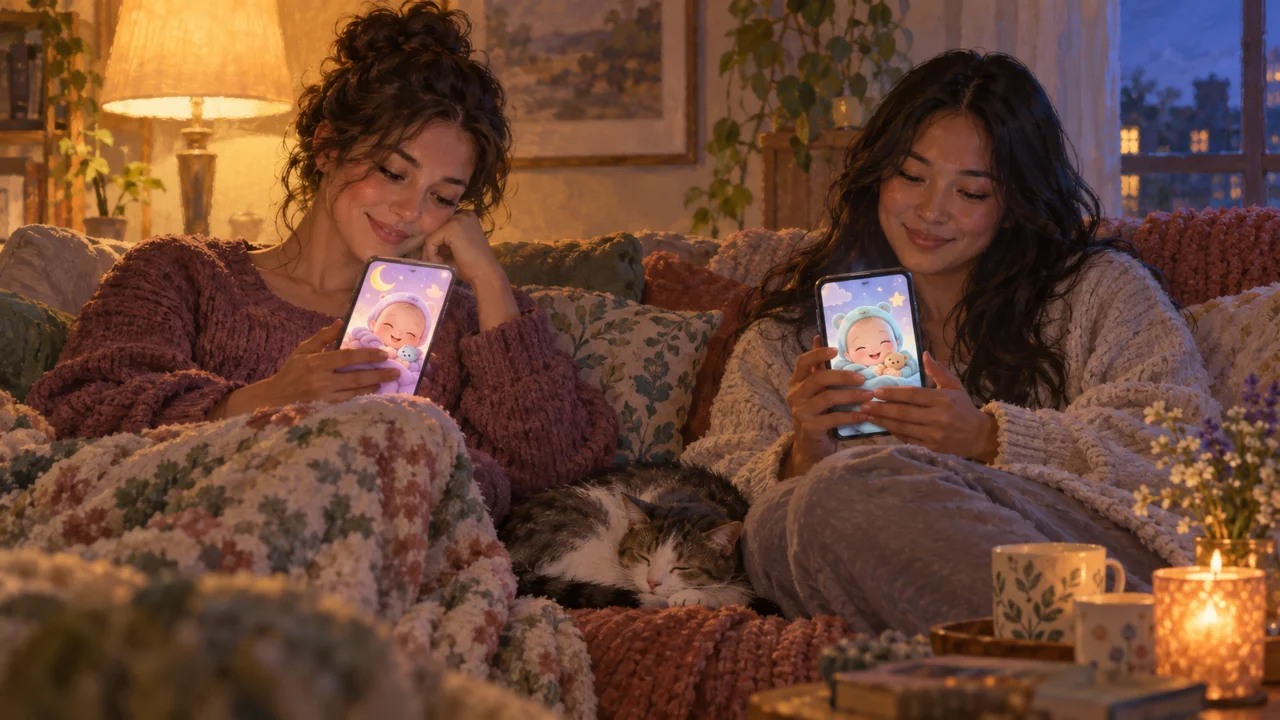
Maybe it started as a quiet sentence on the couch. One of you said I keep thinking about a baby, and the other did not flinch — or did, just a little, and then reached for your hand anyway.
That is usually what sits under a search for a virtual baby app for couples. Not a product hunt for joint bottle timers. Not a TikTok dare. A wish that sounds almost too tender to say out loud: Can we feel a little of this together without turning tonight into a life decision?
A virtual baby will not answer the big questions. It can give the feeling somewhere soft to land — a little one to name, soothe, dress, and notice — while you stay beside each other as partners, not as a project plan.
What Couples Are Really Asking For
When people type virtual baby app for couples, they are rarely shopping for infrastructure. They are shopping for a tone.
Sometimes it is baby fever that will not quiet down. Sometimes it is curiosity about readiness — money, sleep, support, timing — that feels safer if it has a small ritual around it. Sometimes it is simply the ache of wanting to practice tenderness without pretending an app is a shared nursery.
Three honest jobs show up again and again:
- Hold the feeling together without forcing a decision tonight
- Practice talking about care — what feels sweet, what feels like too much
- Share a cozy evening that is warmer than doomscrolling side by side
None of those jobs require native multiplayer, invite-a-partner buttons, or one synced digital baby account. They require presence with each other, and an app that does not overpromise.
Here, co-parenting means emotional practice and conversation — not a fake shared dashboard.
If you are still mapping the wider category, start with our virtual baby app guide and the best virtual baby apps comparison. For the growth-and-ritual angle, see care for a digital baby that grows.
Raising a Virtual Baby Side by Side (Without Fake Features)
The softest pattern looks less like software and more like a date night with quieter lights.
You each keep your own virtual baby — or, if it feels playful, you take gentle turns on one phone. You pick a tiny window: five minutes after dinner, a Sunday morning before coffee gets cold. You do one care loop. Feed. Bath. Outfit. Comfort. Notice one small response. Then you close the apps on purpose.
The couples part is what happens next. Phones down. Two minutes of honest talk.
What felt sweet?
What felt like pressure?
Did anything about readiness come up — timing, money, how tired we already are?
That is the emotional rehearsal. You are practicing how you listen to each other around care, not logging a fictional diaper into a joint tracker. Some people call it co-parenting practice. We mean the conversation muscle, not a product claim.
If one of you wants to keep going and the other wants to stop, that is information too. A ritual that makes you kinder to each other is working. A ritual that turns into a silent scoreboard is not.
For the solo emotional context that often brings people here, read baby fever without getting pregnant. For a broader frame, see virtual child app.

Baby Tracker, Baby Simulator, or Soft Companion?
Search results for a virtual baby app for couples mix three different worlds. Sorting them protects the mood of the evening.
A baby tracker belongs to real life — feeds, sleep, diapers, milestones for a newborn who already exists. Calling a virtual companion a tracker because it shows a hunger icon can send you into the wrong listing on Google Play or the App Store.
A baby simulator can be loud, funny, and perfect for five minutes of shared laughing. It may not hold the emotional tone you want if the real ask is How do we talk about this urge together?
A care companion sits closer to that ask: short nurture loops, continuity, a reason to return without turning the night into chores and ads.
TikTok blurbs labeled “app for couples” blur these lanes on purpose. Pause the clip and ask a quieter question: Is this logging a real newborn, tapping through mini-games, or nurturing a digital companion? Your answer decides whether the download helps the conversation or derails it.
App Privacy (And Why It Matters When Two Hearts Are Involved)
Cute screenshots are not enough — especially when an app is about to sit inside a sensitive talk.
App privacy
Read the app privacy label and the policy before either of you downloads. Notice what personal data is collected, whether care or chat history is stored, whether you can delete it, and whether data is sold or ad-targeted. Continuity should not require giving up quiet. Soft trust language is a starting filter; always verify the live policy.
Ratings, reviews, and update history
Look past the star average. Patterns matter: aggressive ads, broken purchases, guilt notifications, abandoned updates. One frustrated review is normal. A chorus is a warning — and a warning you will feel twice if you both install it.
Ads, coins, and subscriptions
If every sweet gesture is locked behind a coin or an interstitial, the ritual becomes an argument about money and interruptions. Prefer a usable free tier (or a clear optional upgrade) over a bait loop that turns tenderness into a checkout flow.
Age rating and tone
Match the listing to adult comfort. A nurturing adult ritual should not surprise you with kids’-toy chaos or romance framing you never asked for.
Feature honesty
If a listing promises “raise a baby together,” “invite your partner,” or “real co-parenting,” verify those features exist before you plan your evening around them. Category marketing often outruns the product. Our stance is deliberate: we will not invent those features for AIdorable.
Choosing an App for Couples Raising a Virtual Baby
There is no single best virtual baby app for couples for every partnership. Match the feeling you want to hold.
Want light laughs and outfits? A classic baby simulator may be enough. Need real logs for a real newborn? Use a real baby tracker — different job entirely. Want a soft adult ritual that supports a baby-fever conversation? A personal AI care companion — adopt, name, nurture — sits closer to that emotional lane.
Customization helps because it gives you something concrete to talk about. Why that name? Why that outfit? Specificity becomes intimacy without requiring a joint account. If one partner’s baby “looks further along,” remember growth cues are product design, not a grade on who cares harder. Let the differences become conversation fuel, not a silent contest.
Mobile keeps the loop small. Open once in your agreed window. Notice one cue. Do one care action. Notice one response. Close on purpose. Then share one sentence each.
Play on PC
Some people want to play on PC with a larger screen while a partner stays on mobile. Emulators can work for a loud simulator session. For a care-ritual companion, phones are usually enough — and kinder to the mood. Prefer the device that keeps the tone soft, not the one that turns the night into a tech demo.
Push notifications can help a solo habit. For partners, default to optional reminders you both chose. A guilt ping at midnight is not intimacy.

Where AIdorable Fits (Without Overclaiming)
AIdorable is not a couples multiplayer product. It is a personal nurturing ritual that partners can use alongside each other — two little worlds on two phones, and one conversation in between.
The honest shape:
- You adopt, name, and nurture an AI baby
- Care includes feed, bath, outfits, comfort, and short check-ins
- The baby grows and develops personality through care
- Free Care is available; optional Growth if you want more
- Available on iOS, Android, and web
- Non-romantic; not therapy; not a real-baby replacement
- Privacy framing: keep data private / not sold — always verify the live policy
How couples often use it well: each person keeps their own baby; you share one milestone and one feeling; you treat the evening as practice talking about baby fever and readiness; you stop if the ritual intensifies pressure instead of softening it.
What we do not claim: native multiplayer, shared accounts, invite-partner buttons, or synced co-parent trackers. If those are hard requirements, shop for products that document them — and still keep the emotional conversation with each other, not with the feature list.
For more on growth-minded care, return to care for a digital baby that grows. For category shopping, best virtual baby apps stays useful.

A Soft Evening Together (About Fifteen Minutes)
Think of this as a mood, not a scorecard.
Start by naming the job out loud: We’re exploring a feeling, not making a decision. That one sentence protects both of you from mission creep.
Then take a short stretch for parallel care. Each of you opens your own virtual baby experience — or takes gentle turns if sharing one phone feels playful. Do one complete loop. No competing for “best parent” points. Just notice what the little one asks for, and how your body answers.
When you close the apps, leave a few minutes for a shared debrief. Prefer feelings over features. I felt calm when… / I felt rushed when… / This made me wonder about…
Close the loop on purpose. Decide whether to repeat next week, pause, or change the container — a walk, a journal, a talk with someone you trust. Put the phones away.
If either of you leaves more anxious, lonely, or pressured, that is data. Change the pace or stop. A healthy virtual baby app for couples use case should leave you warmer toward each other — not more stuck inside the screen.
Some couples keep a tiny shared note titled “what the ritual brought up” — three lines max: a feeling, a question, a next small step. Do not turn it into a pregnancy project plan. The point is emotional clarity, not a fake parenting syllabus delivered by software.
Privacy and Boundaries Between You
Even without shared accounts, couples share context: screenshots, names you chose, late-night feelings the ritual stirred up. Agree on a few soft boundaries — what stays private to each phone, whether screenshots are okay to send, how you talk about the ritual with friends or family, and what happens if one person wants to quit while the other wants to continue.
Prefer apps with transparent privacy language and clear deletion paths. And keep the human boundary clear: this is not couples therapy, not medical advice, and not a substitute for talking with a professional if readiness conversations keep turning into conflict or grief.
Discover the Best Fit for You Two
Discover the best fit by the job you actually have tonight.
Baby games and mini-games for quick play. Trackers for real logs. An adorable virtual newborn companion if you want to learn how to nurture and feel a little of the joy of care — softly. A classic virtual pet or Tamagotchi scratches a different itch than an AI baby that remembers. The best app for many couples lets you care for a little one today, then put the phone down — not endless play loops.
A heartwarming couples evening may include talking to your baby and watching how your baby will grow. It is still not a real newborn. If you want an adorable virtual newborn with a responsive face, choose companion care over pure simulation. This is practice for tenderness, not a substitute for real-life parenting.
Shop the App Store and Google Play with privacy and tone in mind. Ignore “this app for couples” hype when it cannot show a real co-care feature. Prefer honesty over spectacle. Ask whether the product wants you to perform parenting for an audience or to practice tenderness in private. Couples navigating baby fever usually need the second.
Share the Feeling, Not a Fake Feature List
A virtual baby app for couples is less about unlocking a joint dashboard and more about holding a tender question together: What does this urge want from us right now?
Parallel care, short debriefs, and clear privacy checks will carry you farther than marketing that invents multiplayer co-parenting. Separate trackers from simulators from companions. Keep the loop small. Keep the talk kind. Keep the off switch.
If the version you want is cozy, adult, and non-romantic — a virtual baby each of you can nurture, then talk about without pressure — adopt your AI baby in AIdorable and see whether a tiny daily ritual makes the conversation softer, not louder.